
NAACP vs. The Gerrymander: How GOP Redistricting Is Erasing Black Voting Power Before the 2026 Midterms
NATIONWIDE — October 7, 2026 — With November 3rd just four weeks away, Black voters across the country are facing what NAACP General Counsel Kristen Clarke has described on national television as "legislative Jim Crow." From Louisiana to Virginia, from Tennessee to Alabama, Republican-led state legislatures have systematically redrawn congressional maps in ways that dilute Black political power — and a series of devastating Supreme Court rulings has made those efforts dramatically harder to challenge in court.
The NAACP has filed lawsuits, emergency injunctions, and Supreme Court petitions in multiple states. Civil rights organizations are mobilizing at a scale not seen since the original passage of the Voting Rights Act in 1965. And Black voters are being forced to navigate a landscape of ballot restrictions, new ID requirements, purged rolls, and redrawn maps — all in the weeks before one of the most consequential midterm elections in a generation.
The Supreme Court's Role in Dismantling Voting Rights
This spring, the Supreme Court's ruling in Louisiana v. Callais eliminated Section 2 protections against lawmakers drawing maps that dilute the political power of minority voters — protections that had been a cornerstone of the Voting Rights Act. The decision was immediately condemned by civil rights advocates as a continuation of more than a decade of judicial erosion of the Act's protections.
The Brennan Center for Justice called the decision "the destruction of what little remained of the Voting Rights Act." Critics noted that the ruling's reasoning relied in part on cherry-picked data to argue that racial disparities in voting participation are no longer a problem — an argument many voting rights scholars described as factually unsound.
The Callais ruling has had immediate ripple effects. Multiple states have already moved to eliminate fair congressional districts that provided meaningful representation for Black voters, emboldened by the legal cover the decision provides.
State by State: Where Black Voting Power Is Under Attack
In Louisiana, the federal court order protecting a majority-Black congressional district was challenged all the way to the Supreme Court and reversed. In Virginia, state lawmakers are advancing redistricting maps that strip Black voters of meaningful electoral influence. In Tennessee, Republican leaders moved to redraw U.S. House districts while limiting public input, even as hundreds of protesters flooded the state Capitol. NAACP Tennessee State Conference President Gloria Sweet-Love described the moment as "a return to a time before the Voting Rights Act existed."
In Texas, an unprecedented mid-decade redistricting effort — begun in August 2025, five years ahead of the 2030 Census — was greenlit by the Supreme Court despite challenges arguing that the new maps dilute minority voting power. In response, over a dozen other states have begun considering their own map revisions, potentially affecting ballots and polling locations for millions of voters before November 3rd.
The SAVE Act and New Barriers at the Ballot
Compounding these redistricting threats is the SAVE Act, federal legislation that would require documentary proof of U.S. citizenship to register to vote. Critics argue the requirement would create new barriers for women who changed their names after marriage or divorce, rural voters, and military voters. "If it was focused on election security, we already have security measures in place," said the CEO of the League of Women Voters. "It would be fortifying those current things."
The Congressional Black Caucus Foundation has launched a Voting Rights Scorecard covering voting laws in 15 key states, providing Black communities with state-specific guidance on what documentation they need and where to vote on November 3rd.
What's at Stake for Black Georgia
For Black Georgians, the 2026 midterms carry outsized significance. Georgia's thin congressional margins are in play, and with key down-ballot contests also on the ballot, the concentration of Black voting power in metro Atlanta and South Georgia has never been more critical. Voter registration deadlines are approaching — check your registration status at Georgia My Voter Page today.
Nationally, if Democrats regain the House, Congressional Black Caucus Chair and House Minority Leader Hakeem Jeffries is positioned to become the first Black Speaker of the House — a historic milestone with direct implications for the legislative priorities that affect Black communities.
What You Can Do Before November 3rd
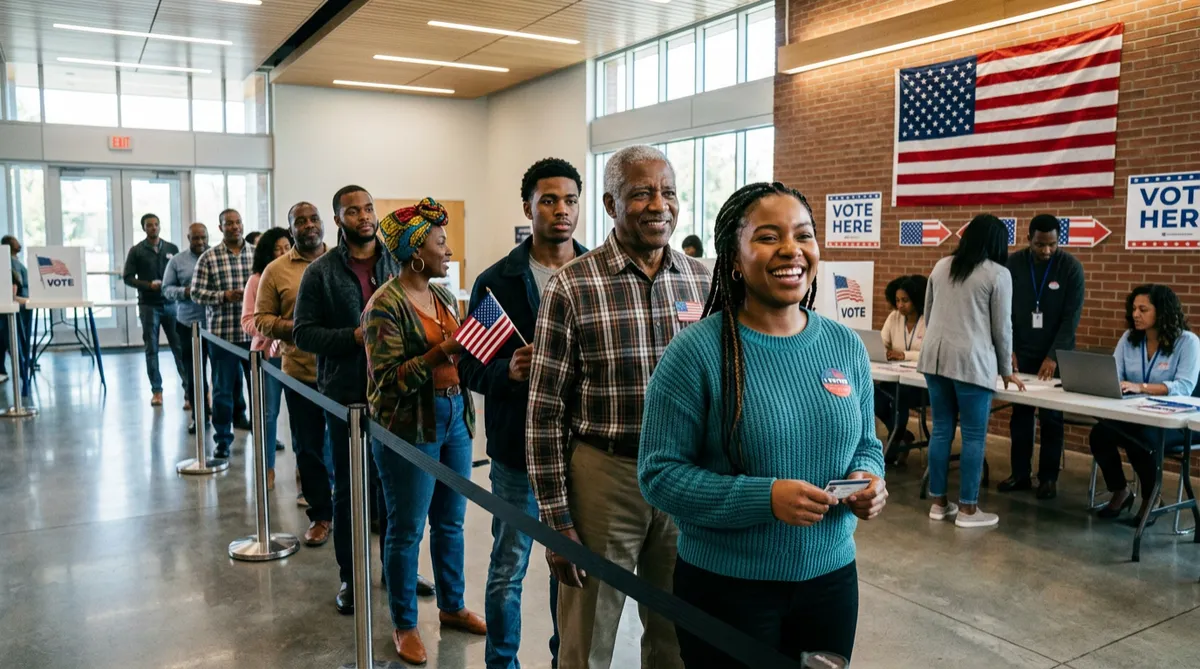
Verify your voter registration. Check your polling location — redistricting may have changed it. Know your state's ID requirements. Make a voting plan. Talk to everyone in your circle about the stakes. The NAACP's voter protection hotline is available to assist with any questions or issues on election day. The fight for Black voting power is being waged in courthouses across America — but the most important battlefield is the ballot box on November 3rd.

Activate Your Merkaba: 20 Chapters of Knowledge