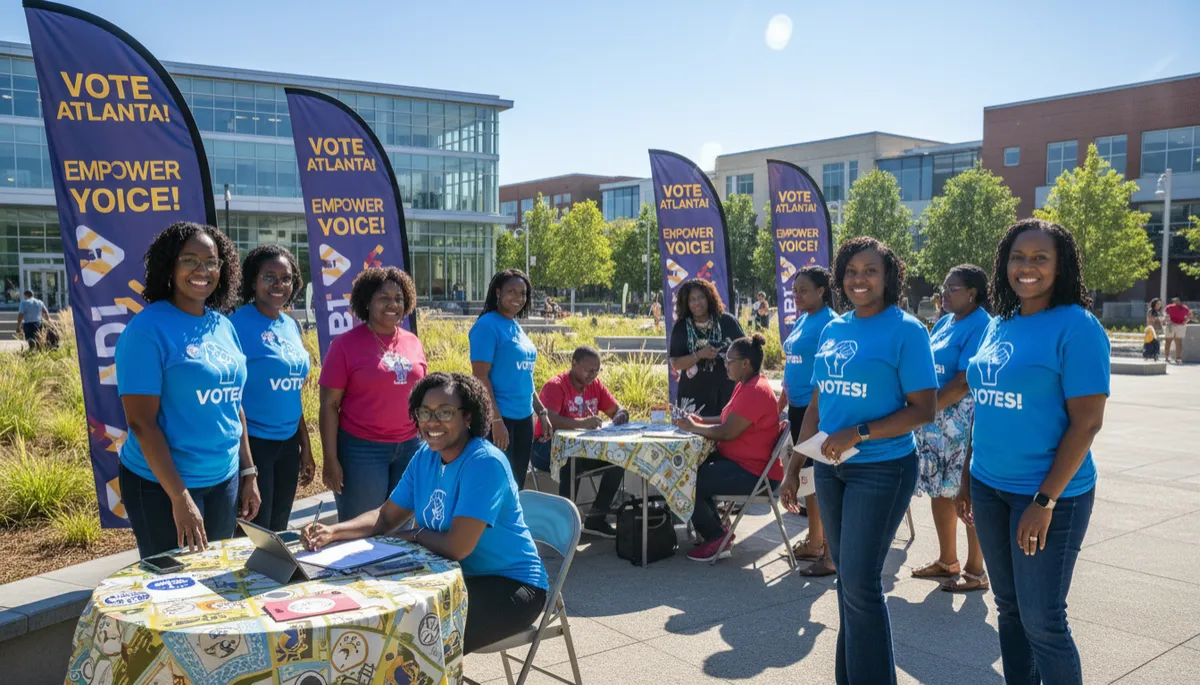
191 Black Legislative Seats at Risk: The Voting Rights Battle Defining Our Democracy
Our Voice in Democracy Is Under Siege
In America's 250th year, one of the most fundamental rights Black Americans fought, bled, and died for is under coordinated attack. The right to vote — and the right to have that vote actually count — is facing its most serious challenge in decades. And if we don't act now, the consequences will be felt for generations.
The Supreme Court's decision in Louisiana v. Callais sent shockwaves through civil rights organizations across the country. The National Urban League estimates that the ruling puts 191 Black-held state legislative seats at risk. Let that number sink in: nearly 200 Black elected officials who represent Black communities, advocate for Black policies, and ensure Black voices are heard in state capitals across America could lose their seats — not because they lost an election, but because maps are being drawn to silence us.
The Redistricting Assault
Redistricting — the redrawing of electoral district boundaries — is a once-per-decade process that follows the U.S. Census. In theory, it's a neutral administrative exercise. In practice, it has always been a political battlefield where the party in power tries to lock in its advantages for the next decade. But what's happening in 2026 is different in scope and brazenness.
Following Supreme Court rulings that have weakened the Voting Rights Act, states across the South and Midwest are drawing boundaries that crack, pack, and dilute Black voting communities. Texas began an unprecedented effort to redraw its maps five years early. Over a dozen states are following suit ahead of the November 2026 midterms. The result: in state after state, maps are being drawn that split Black neighborhoods, combine them into overwhelmingly white districts, or pack them into districts that give Black voters only one voice where they once had two or three.
The SAVE Act Threat
The redistricting crisis is compounded by another looming danger. The SAVE Act, if implemented, would add documentary proof-of-citizenship requirements to the voter registration process. The National Urban League warns that as many as 21 million Americans — disproportionately Black, Latino, and low-income — could face disenfranchisement as a result.
For many Black Americans, particularly older voters in Southern states, obtaining documentary proof of citizenship is not simple. Birth certificates were not always issued for Black births during the Jim Crow era. Identity documents cost money and time. The SAVE Act's requirements, while presented as a fraud-prevention measure, would function as a modern-day literacy test — a bureaucratic barrier designed to keep Black voters away from the polls.
What This Means for Georgia and Atlanta
Georgia is ground zero in the fight for Black voting rights. In 2020 and 2021, Black voters in Georgia made history — turning the state blue in the presidential election and electing Raphael Warnock as the first Black senator in Georgia's history. That historic mobilization was the culmination of years of grassroots organizing by groups like Fair Fight, New Georgia Project, and Georgia NAACP.
And it made Georgia a target. Since then, the state has passed legislation restricting drop boxes, limiting early Sunday voting (which had benefited Black church communities through Souls to the Polls efforts), and criminalizing offering food or water to voters standing in long lines — lines that tend to be far longer in predominantly Black precincts. Now, with maps being redrawn and the SAVE Act looming, the stakes for Atlanta's Black community in November 2026 could not be higher.
The History That Made This Moment
We cannot understand the urgency of this moment without understanding the history. The Voting Rights Act of 1965 was not a gift — it was won through sacrifice. John Lewis, Amelia Boynton, and hundreds of brave marchers crossed the Edmund Pettus Bridge in Selma on March 7, 1965 — a day known as Bloody Sunday — only to be beaten by state troopers. Their courage moved the nation and resulted in the most powerful voting rights legislation in American history.
That law ended poll taxes and eliminated literacy tests. In 2013, the Supreme Court gutted its backbone in Shelby County v. Holder, eliminating the preclearance requirement that had forced Southern states to get federal approval before changing voting laws. The floodgates opened. And voter suppression has escalated systematically since.
What We Must Do Right Now
The good news is that we know what works: organized, sustained voter mobilization. When Black voters show up in overwhelming numbers, the suppression math breaks down. Here is what every Black Atlantean must do before November 3, 2026:
Register now. Check your registration status at Georgia My Voter Page. Even if you have voted before, recent voter roll purges may have removed your registration without your knowledge.
Vote early. Georgia allows early in-person voting. Spread the dates through your church, workplace, family group chat, and social media. The more people who vote early, the better.
Bring five people. Personal contact is the most effective voter mobilization tool. Don't just post about voting — call your relatives, drive your neighbors to the polls, and make sure everyone in your circle participates.
Know your rights. If you're told you're not on the rolls, request a provisional ballot. If you encounter problems, call the voter protection hotline: 1-866-OUR-VOTE.
Support the organizations doing this work. Fair Fight, New Georgia Project, Georgia NAACP, and the National Urban League's local affiliates need volunteers and donors right now.
The Bottom Line
Sixty years after the Voting Rights Act, Black America is being forced to fight for the same rights our ancestors secured through immense sacrifice. But we have something they didn't: numbers, technology, organization, and the knowledge of exactly what's at stake. 191 Black legislative seats. 21 million potential voters at risk. And a November election that will define what Black political power looks like for the next decade. Vote like your rights depend on it — because they do.




