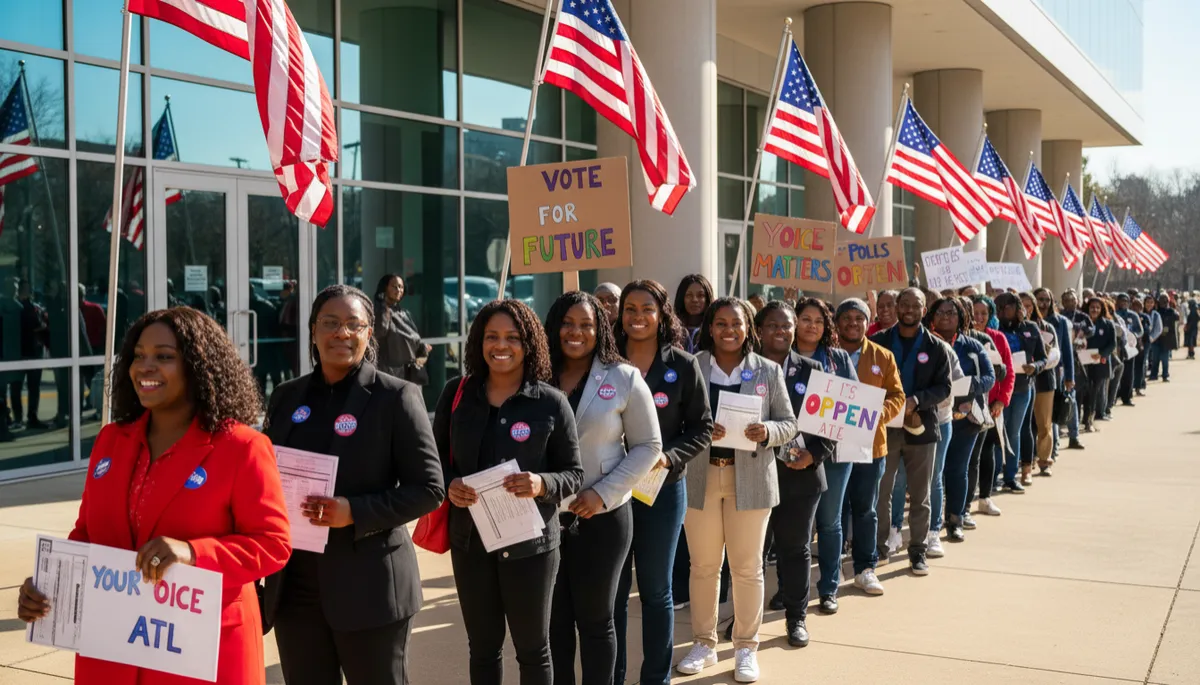
$20 Million and Rising: The Campaign to Mobilize Black Voters After the Supreme Court's Attack on Minority Representation
$20 Million and Rising: The Campaign to Mobilize Black Voters After the Supreme Court's Attack on Minority Representation
Black political power is under direct assault -- and the response must be swift, organized, and massive. A major coalition has launched a $20 million campaign to mobilize Black voters following a Supreme Court decision expected to dramatically reduce the number of nonwhite members of Congress. This is not an abstract policy debate. This is a fight for our seat at the table of American democracy.
The stakes could not be higher. When Black communities have representation in Congress, we get policies that address our healthcare needs, our economic conditions, our schools, and our safety. When that representation is stripped away, the consequences reverberate through every aspect of our lives. This $20 million campaign is a direct, organized response -- and every Black Atlantean needs to be part of it.
What the Supreme Court Did
The Supreme Court ruling at the center of this mobilization effort is expected to reduce the number of majority-minority congressional districts -- the districts specifically drawn to ensure that communities of color can elect representatives of their choice. These districts have been one of the primary vehicles through which Black Americans have achieved congressional representation since the Voting Rights Act of 1965.
Critics of the ruling argue that it effectively continues a pattern of dismantling the legal architecture that protects Black political power. Civil rights organizations are calling it one of the most significant blows to minority voting rights in decades.
The Broader Assault on Black Voting Rights
This ruling does not exist in isolation. Between 2021 and 2025, 187 laws restricting access to voting were passed across 23 states. These laws -- targeting voter ID requirements, early voting periods, mail-in ballots, and registration processes -- disproportionately impact Black, Brown, and low-income voters. Legal scholars have called this the most sustained legislative attack on voting rights since the Jim Crow era.
The National Urban League's 2026 State of Black America report connects these developments explicitly to declining Black economic and political outcomes. The mechanisms of democracy are being narrowed at exactly the moment when Black communities need them most.
The $20 Million Response
The coalition behind this campaign is not sitting still. The $20 million mobilization effort is designed to do several things simultaneously:
- Voter registration: Reaching unregistered Black voters in key states and helping them navigate new registration requirements.
- Voter education: Making sure Black communities understand what is at stake in the 2026 midterm elections and beyond, and how to vote in the face of new restrictions.
- Turnout operations: Funding community-based get-out-the-vote efforts in neighborhoods that have historically had lower turnout due to suppression and disengagement.
- Legal challenges: Supporting litigation that fights back against the most egregious voter suppression laws in court.
This is the kind of coordinated, well-resourced response that the moment demands. And it needs the participation of every Black voter in America -- including every Black Atlantean.
Why Atlanta Matters
Atlanta is not just a city. It is the cradle of the American civil rights movement. It is the city where Dr. Martin Luther King Jr. dreamed and preached and organized. Where John Lewis marched and legislated. Where Stacey Abrams built the voter registration infrastructure that flipped Georgia blue in 2020 -- a political earthquake that proved what organized Black voting power can accomplish.
Georgia's congressional districts are among those expected to be affected by the Supreme Court ruling. Atlanta's Black communities have enormous stakes in how these districts are redrawn and which candidates run in them. The 2026 midterms are a defining moment -- and Atlanta must show up.
What You Must Do Now
Civil rights leaders have been clear: voting should be the first chess move, not the last. Here is your action plan:
- Confirm your voter registration today. Visit vote.org or your state's official election website to verify your registration status. New laws may have changed requirements in your state.
- Know your polling location and early voting options. Rules have changed in many states. Do not assume what worked in 2024 still applies.
- Volunteer for voter registration drives. Your time is one of the most powerful contributions you can make. Organizations like the NAACP, New Georgia Project, and local church networks are actively recruiting volunteers.
- Have the conversation. Talk to your family, friends, coworkers, and neighbors -- in barbershops, beauty salons, at cookouts, and on social media. Normalize voting as a community expectation, not just an individual choice.
- Donate to organizations fighting for voting rights in the courts and on the ground.
- Attend local political meetings. Know who your city council members, state legislators, and congressional representatives are. Show up to town halls. Make your presence known.
The Cost of Staying Home
Every election that Black communities sit out is an election that shapes our lives without our input. Healthcare policy. School funding. Policing. Housing. Infrastructure. Economic opportunity. These decisions are made by elected officials -- and elected officials respond to voters.
The $20 million campaign is a powerful signal that our leaders understand the urgency of this moment. But no amount of funding replaces the individual decision of each Black voter to show up. The most sophisticated mobilization operation in history cannot work if people stay home.
Atlanta, we know how to do this. We have done it before -- in 2020, in the Senate runoffs, in city elections that changed the direction of this city. We have proven that when Black Atlanta is mobilized, we change outcomes. Now it is time to do it again. Register. Educate. Organize. Vote. The fight for our representation -- and our future -- depends on it.




