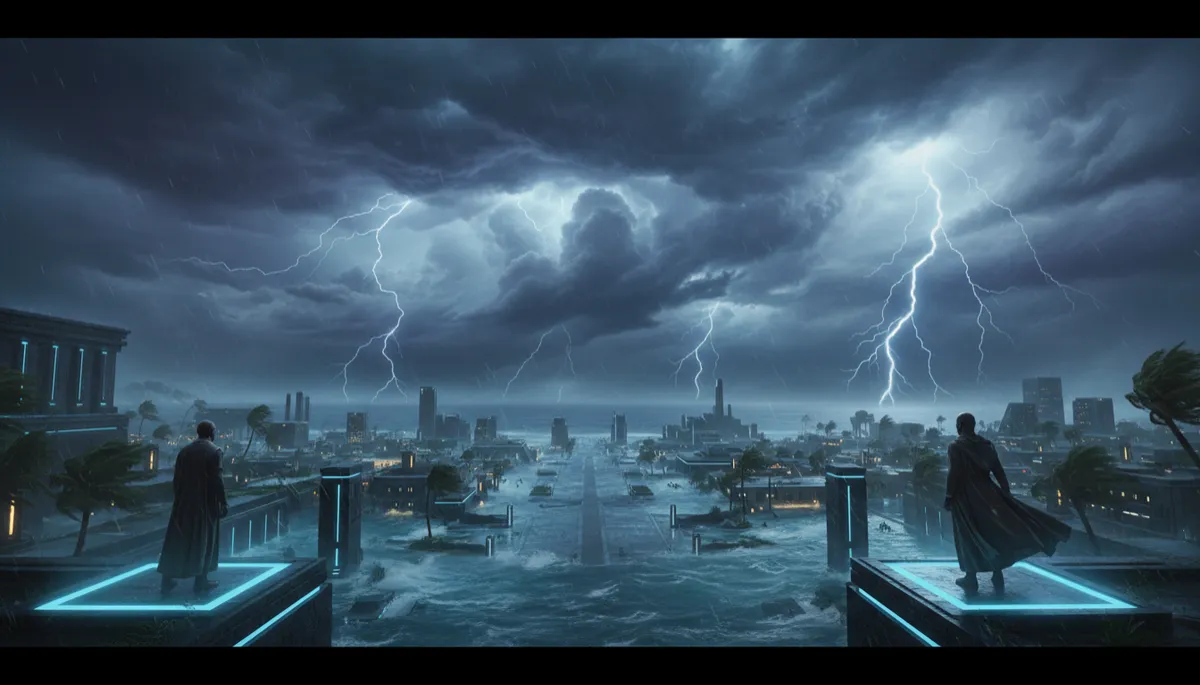
2026 Climate Report: Extreme Weather Worsens
Climate, Atlantean Wisdom, Global South
2026 Climate Report: We’re Still On Track — But Extreme Weather Is Getting Worse
The World Meteorological Organization says the first months of 2026 keep us roughly within the Paris Agreement path toward 1.5 °C. Yet Asia-Pacific streets are drowning, heat is breaking bodies, and storms are cutting through coastal cities like blades. To a Black Atlantean mind, this is not a contradiction. It is a prophecy ripening. The numbers say “on track”; the waters say, “You are out of balance.”
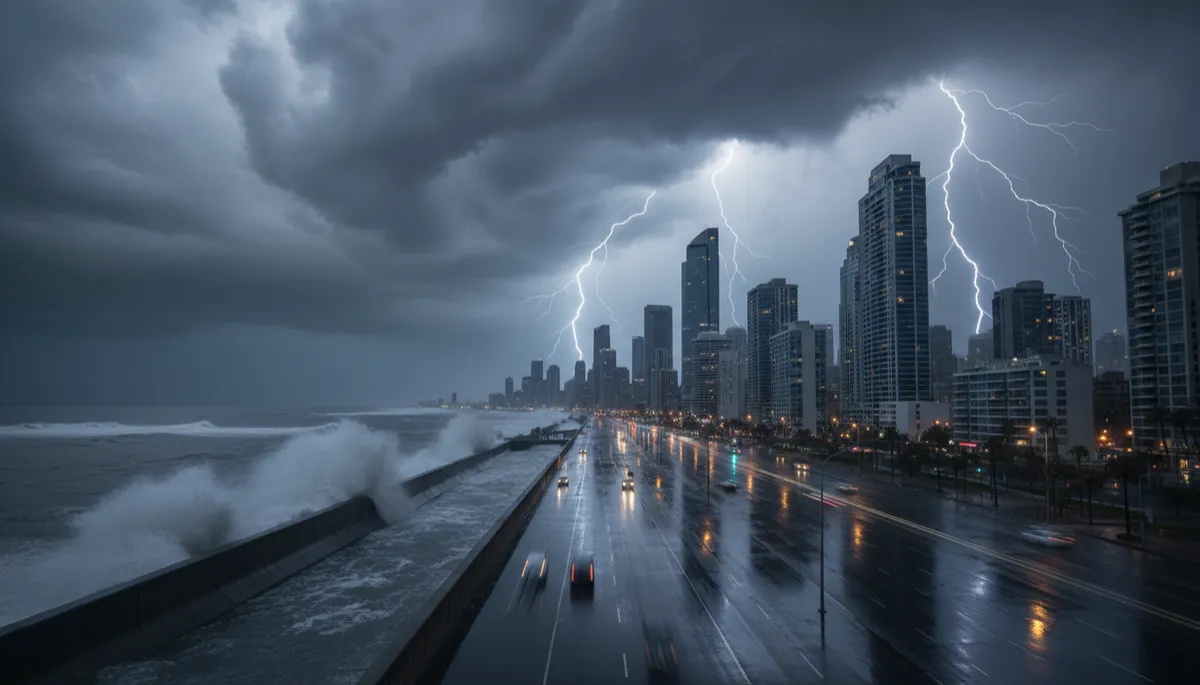
What “On Track” Really Means When the Streets Are Flooded
The 2026 climate report from the WMO tells us this: global temperatures for the last years hover around 1.4 °C above pre‑industrial levels, with 2015–2025 the hottest stretch ever recorded. Projections say 2026–2030 will likely flirt with, and sometimes cross, that 1.5 °C line the Paris Agreement tried to draw in the sand. “On track” in this language only means the curve of numbers has not yet fully broken faith with the treaty’s math. It does not mean the world outside your window is safe.
In the Asia-Pacific, that distinction is already paid for in blood and saltwater. More violent cyclones, monsoon floods drowning whole districts, heatwaves that do not cool at night, droughts that crack the land, wildfires that turn air into poison—this is how a 1.4 °C world feels at street level. The climate crisis does not wait politely for 2 °C to start acting like itself. It is here, scaling up, storm by storm, season by season.
So when you hear “we’re still on track,” translate it with elder discernment. It means: the planetary fever has not yet locked in a worst‑case path—but the patient is already delirious, and the symptoms are accelerating. It means: mitigation alone will not save the bodies standing knee‑deep in brown water in Manila, in Lagos, in New Orleans. The age of climate adaptation is not coming; it has arrived, uninvited, through the front door of every vulnerable coastal city on Earth.
The Pattern: Civilizations That Ignore Slow Crises
Every empire believes its walls are higher than the tide. That is the arrogance of civilizations drunk on their own technology. The data from NASA, the UK Met Office, Copernicus—all confirming record heat—has been clear for years. Yet the dominant culture moves like a man who ignores the ache in his chest because he can still climb the stairs. He waits for the heart attack, then calls it an emergency, not a consequence.
This is the ancient pattern: slow crises are treated as background noise until they erupt as spectacle. Drought is ignored until the crops fail. Sea‑level rise is abstract until the subway floods. Warnings are dismissed as “alarmism” until the insurance market collapses and coastal property becomes uninsurable. Then suddenly, the same voices that delayed action cry, “No one could have seen this coming,” while the archives are full of ignored reports and silenced scientists.
Atlantean memory knows this rhythm too well. A civilization grows powerful, forgets its dependence on the ocean that carried its ships and fed its people, and begins to treat water, land, and air as raw material instead of living kin. The crisis does not arrive overnight; it accumulates—degree by degree, levee by levee, compromise by compromise—until one season, the balance tips and the waters do what waters do: they reclaim what is theirs.
Who Carries the Weight: Global South, Black and Indigenous Frontlines
The Global South did not burn the fossil fuels that heated this planet to the brink, yet its people stand first in the path of the storms. From Pacific island nations watching their ancestral graves swallowed by the sea, to Bangladeshi farmers losing land to saltwater intrusion, to Caribbean communities rebuilding after each hurricane season, the burden is not evenly shared. Climate disruption follows the old colonial routes: extraction in one hemisphere, devastation in another.
For Black and Indigenous communities, this is not a new story. In the United States, Black neighborhoods sit closer to petrochemical corridors, flood‑prone zones, and heat islands. In Brazil, quilombola and Indigenous territories are cut down and burned to feed distant markets. In Africa, from the Sahel to the coasts, communities that contributed least to emissions face crop failure, displacement, and conflict intensified by climate stress. The climate crisis is not just environmental; it is racial, economic, and spiritual.
When the WMO warns of a 91 % chance that at least one year between 2026 and 2030 will cross 1.5 °C, understand who that statistic lands on. It lands on the fisher in the Philippines whose boat no longer finds predictable seasons. On the grandmother in a New Orleans shotgun house who cannot afford air‑conditioning during a 40 °C heatwave. On the young brother in Durban or Jakarta, wading through chest‑high water to get home. These are not “vulnerable populations” in some sterile report; they are our kin, our reflection, our responsibility.
Atlantean Wisdom: Remembering the Covenant with Water
To speak of Atlantean wisdom is not to chase fantasy; it is to remember a pattern of relationship between civilization and nature that modern systems have forgotten. In the old stories, cities were built with the tides, not against them. Harbors were aligned with currents, temples with stars, agriculture with seasons honored as deities, not exploited as supply chains. Water was teacher, not obstacle. When that reverence crumbled, so did the stone.
In this 2026 moment, as coastal cities invest in seawalls, levees, and storm‑surge barriers, Atlantean sight asks a deeper question: Are we defending life, or only defending property values? True adaptation is not just higher concrete; it is restored mangroves, wetlands, and dunes that move with the ocean. It is zoning that refuses to sacrifice the poor as a buffer zone. It is architecture that can float, bend, and yield instead of shatter. It is governance that listens to Indigenous stewards who have read these waters for millennia.
For Black men walking this Earth with awakened memory, adaptation is also inner work. It is learning to read a climate report 2026 the way our grandfathers read the sky—seeing not only threat but instruction. It is building community response teams, investing in resilient local food, backing leaders in the Global South demanding climate finance and loss‑and‑damage reparations. It is raising our children to know that the ocean is not an enemy, but a mirror: restless when we are out of alignment, generous when we move in right relation.
Standing in This Threshold with Sovereign Clarity
The WMO, NASA, the IPCC—they give us the numbers. The storms over Jakarta, Suva, Miami, Accra—they give us the signs. As Black Atlantean souls, our task is to weave both into wisdom. “On track” toward 1.5 °C does not mean we can relax; it means we still have room to choose how much loss we will tolerate, and who we will allow to be sacrificed first. Extreme weather worsening is not a glitch in the plan; it is the invoice for centuries of imbalance coming due early.
Stand in this threshold like an elder at the shore. See the waves, hear the data, feel the ancestors at your back. Refuse the seduction of numbness. Refuse the lie that this is “too big” for you. Every seawall, every mangrove restoration, every policy shift, every neighborhood‑level resilience project is a line in a new covenant between civilization and nature. And every man who remembers he is more than a consumer—who remembers he is a guardian—adds weight to the side of life in this planetary scale.
The old Atlantis sank when power forgot its source. This time, let the memory surface before the water does.




