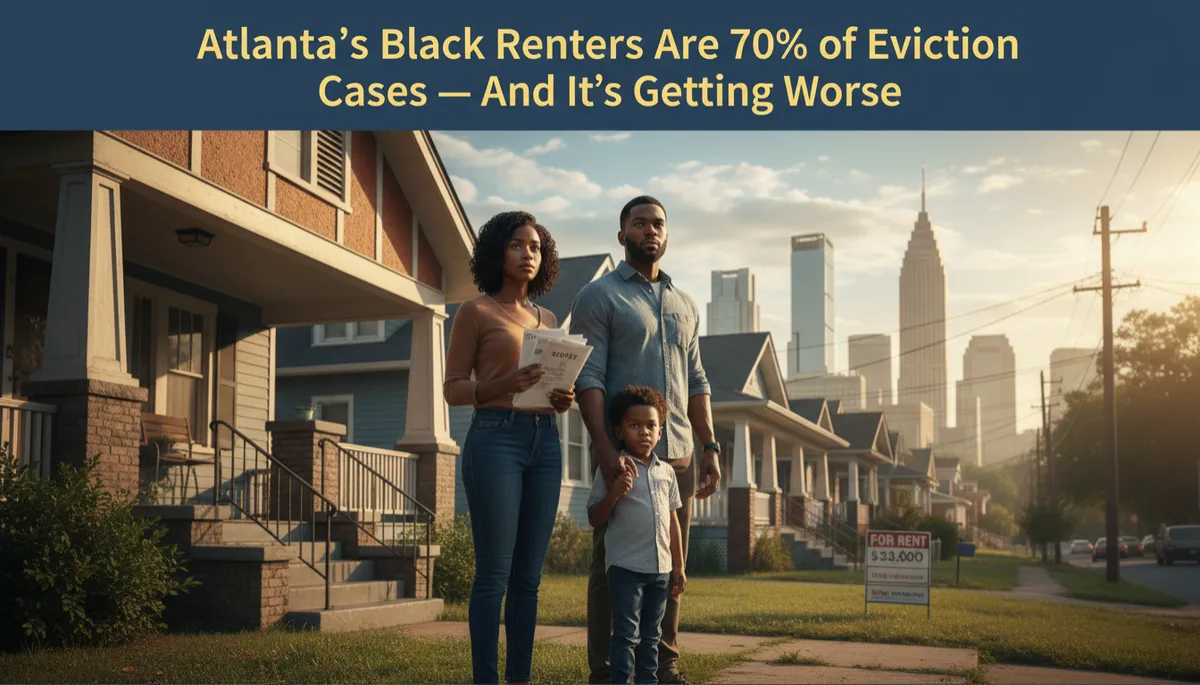
Atlanta's Black Renters Are 70% of Eviction Cases — And It's Getting Worse
Atlanta's Black Renters Are 70% of Eviction Cases — And It's Getting Worse
In Atlanta, the city built on Black excellence, Black resilience, and Black economic power, a quiet crisis is unfolding — one that is tearing families apart, destabilizing neighborhoods, and threatening the foundation of one of America's most important Black communities.
Black renters now make up 70% of eviction cases in the Atlanta region. That is not a typo. Despite representing just 52% of the area's population, Black Atlanteans account for seven out of ten eviction filings processed in local courts. Officials are sounding the alarm — and the Black community needs to sound it louder.
How Did We Get Here?
Atlanta's housing crisis has been decades in the making, but several forces have combined in recent years to push the eviction rate among Black renters to this breaking point.
Skyrocketing rents. Atlanta's rental market has been one of the hottest in the country. Average rents in many in-town neighborhoods have doubled over the past decade. In neighborhoods like Old Fourth Ward, Vine City, Mechanicsville, and Pittsburgh — historically Black communities that have anchored Atlanta's Black cultural identity for generations — rents that were once accessible to working-class Black families are now priced for an entirely different demographic.
Gentrification without protection. The rapid transformation of Atlanta's neighborhoods has not been accompanied by meaningful tenant protections. Georgia is one of the most landlord-friendly states in the country: there is no statewide rent control, limited just-cause eviction requirements, and a court process that moves fast — often faster than tenants can find legal help or alternative housing.
Income inequality. The racial wealth gap is not an abstraction in Atlanta — it shows up in the eviction court every single day. Black Atlanteans, who have historically been locked out of wealth-building opportunities through discriminatory lending, redlining, and employment barriers, are disproportionately renters. And as renters in a city with no meaningful tenant protections, they are disproportionately vulnerable.
Post-pandemic economic pressure. The economic disruptions of the early 2020s hit Black workers and Black families hardest. Emergency rental assistance programs have expired. The safety net has frayed. And landlords, many of whom are now large corporate entities rather than individual property owners, are not waiting.
The Human Cost
Behind every eviction filing is a family. Often, it is a single mother working two jobs who fell one month behind when her car broke down. It is an elderly man on a fixed income who saw his rent increase by $400. It is a young couple who moved to Atlanta chasing opportunity and found themselves caught in a market that was never designed for them to succeed.
Eviction has cascading consequences. An eviction record makes it nearly impossible to rent another apartment. It disrupts children's schooling. It strains mental health. It forces families into overcrowded situations with relatives, or worse, into homelessness. And in Atlanta, where the racial wealth gap is already severe, an eviction can set a family back financially for years.
What Officials and Advocates Are Saying
Community advocates and housing organizers in Atlanta have been sounding the alarm for years. The data confirming that Black renters make up 70% of eviction cases is damning — and it is prompting calls for urgent action at every level of government.
Organizations like the Atlanta Volunteer Lawyers Foundation, the Georgia Advancing Communities Together (ACT), and the Atlanta Neighborhood Development Partnership are on the front lines, providing legal aid to renters facing eviction, advocating for policy changes, and helping families navigate a system that is stacked against them.
At the city level, there are calls for expanded emergency rental assistance programs, stronger tenant notification requirements, and a more robust right to counsel for renters facing eviction. At the state level, advocates are pushing for just-cause eviction protections and limits on rent increases — though in Georgia's current political climate, progress has been slow.
What You Can Do Right Now
If you or someone you know is facing eviction in Atlanta, here is what you need to know:
- Contact Atlanta Legal Aid: Atlanta Legal Aid Society provides free legal services to low-income residents facing eviction. Call 404-524-5811 or visit atlantalegalaid.org immediately upon receiving an eviction notice.
- Know your notice rights: In Georgia, landlords must give at least 60 days' notice for a month-to-month tenancy termination (for leases of more than one year). Know your lease terms and demand proper notice.
- Attend your court date: Missing a court date almost guarantees a default judgment against you. Show up, even without a lawyer — and apply for a continuance to get legal help if needed.
- Apply for emergency rental assistance: Fulton County and DeKalb County periodically open emergency rental assistance programs. Check your county's website and community development offices regularly.
- Connect with your neighbors: Tenant organizing is one of the most powerful tools against displacement. Connect with tenant associations in your building or neighborhood.
A City Worth Fighting For
Atlanta is the city that produced John Lewis, Maynard Jackson, C.T. Vivian, and a thousand other champions of Black freedom and Black excellence. The idea that its Black residents are being displaced from their own city — one court filing at a time — should be unacceptable to every Atlantean.
The eviction crisis is not inevitable. It is the result of policy choices. And policy choices can be changed — but only if we organize, advocate, and refuse to let this crisis become invisible.
Atlanta's Black community built this city. We are not going anywhere without a fight.




