Atlanta's Moment: How the FIFA World Cup Is Putting Black Culture on the Global Stage
Atlanta's Moment: How the FIFA World Cup Is Putting Black Culture on the Global Stage
July 12, 2026 | By Black Atlanteans
The world came to Atlanta this summer — and Atlanta was ready. The 2026 FIFA World Cup has done more than bring world-class soccer to Georgia. It has given this city something it has quietly earned for decades: a global stage to show what Black Atlanta is made of.
And we are not wasting the moment.
A City Built on Black Excellence
Atlanta has always been a Black city in the fullest sense of the word. From Auburn Avenue — once dubbed the richest street in Black America — to the birthplace of the Civil Rights Movement, from the campuses of the AUC (Atlanta University Center, home to Morehouse, Spelman, Clark Atlanta, and more) to the headquarters of Black-owned media empires that shaped American culture, Atlanta's identity is inseparable from Black excellence.
When FIFA selected Atlanta as a host city for the 2026 World Cup — one of eight matches, including a semifinal — it was choosing one of the most culturally significant Black cities on earth. The international soccer community may have been drawn by the stadium capacity and the infrastructure. But what they found when they got here was a culture that stopped them in their tracks.
The Atlanta Cultural Exchange
Before the first match kicked off, Mayor Andre Dickens and his Office of Cultural Affairs made a deliberate declaration: Atlanta would not just host the World Cup — it would showcase who it truly is.
The Atlanta Cultural Exchange was launched as the city's primary cultural platform during the tournament, designed to give Atlanta's creative community a global audience it has always deserved. Adriane V. Jefferson, Executive Director of the Mayor's Office of Cultural Affairs, described it as a legacy opportunity that extends far beyond the tournament itself: "Atlanta already has culture. We just have to raise the bar in the visibility of it."
The program featured rapper and activist Killer Mike, entertainment executive Ray Daniels, Trinidad James, and a wide array of visual artists, musicians, and cultural leaders. The Atlanta Cultural Exchange brought together organizations including the Atlanta Symphony Orchestra, Atlanta Opera, ZuCot Gallery, One MusicFest, HBCU Made, and Historically Black Since — a who's who of Atlanta's cultural infrastructure on full display for an international audience.
This was not a performance for visitors. It was Atlanta telling its own story on its own terms, to the world.
250,000 Visitors. One Message: This Is Black Atlanta.
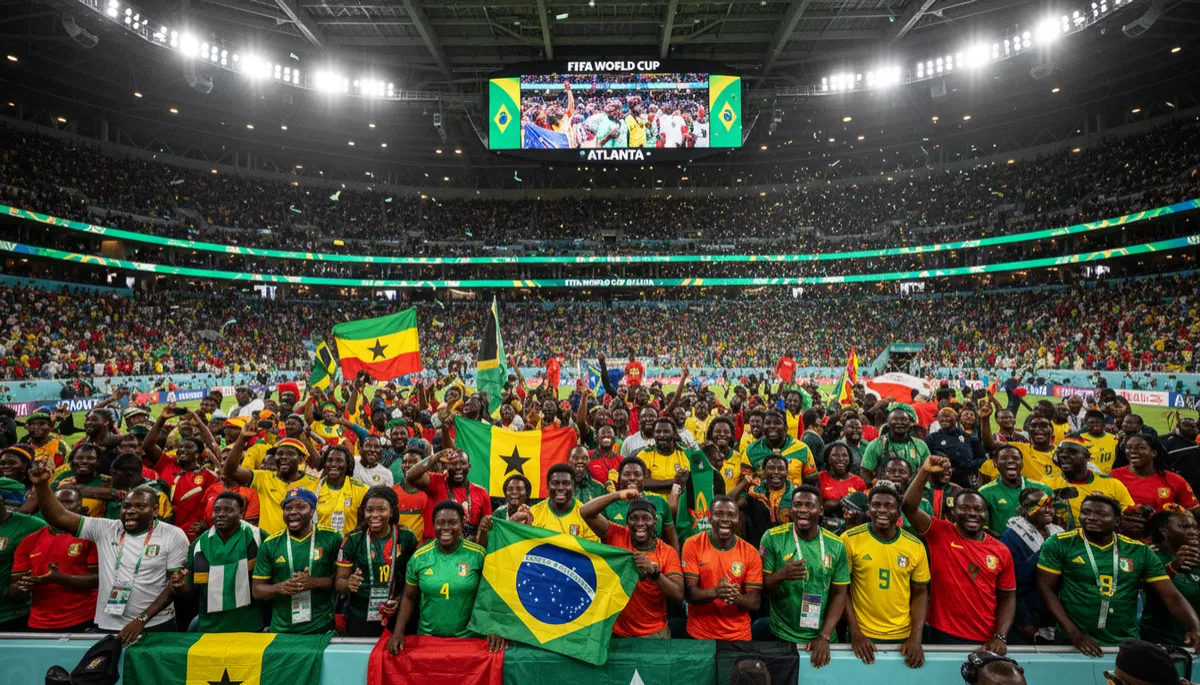
The numbers have been staggering. Over 250,000 fans descended on Centennial Olympic Park for the official FIFA Fan Festival, transforming the heart of downtown Atlanta into a global party. Fans from Senegal, Morocco, Nigeria, Cameroon, Brazil, Argentina, England, and dozens of other nations walked the same streets that John Lewis walked during the Civil Rights Movement. They visited the National Center for Civil and Human Rights. They explored the Auburn Avenue Research Library on African American Culture and History. They stopped at the APEX Museum — the oldest Black history museum in Atlanta.
Many of them, for the first time, encountered the depth of Black Atlanta's history and power. And for Black Atlanteans who walked those streets alongside them, there was a quiet, powerful pride in that recognition.
The African Connection
This World Cup was especially meaningful for Black Atlanta because of the unprecedented representation of African national teams in the tournament. A record 10 African teams qualified for the 2026 World Cup — and for a city with deep ties to the African diaspora, that meant something profound.
Families who immigrated from Liberia, Sierra Leone, Nigeria, Ghana, Ethiopia, and across the continent brought their traditions, their colors, their languages, and their passion into Atlanta's streets. And Black Atlanteans — many of whom share direct ancestral and cultural ties with those nations — met them with open arms.
Soccer, as one Black Atlanta fan put it, is a universal language. "Atlanta's soccer culture blends Black identity, fashion and creativity, making the city a perfect stage for the World Cup."
More Than a Tournament
When the last match is played and the World Cup leaves Atlanta, what will remain is not just the memories of great soccer moments. What will remain is the proof of what Black Atlanta can do when given a global platform.
The Atlanta Cultural Exchange created programming that will outlast the tournament. The artists who performed got international exposure that opens doors for years. The small Black-owned restaurants, vendors, and businesses that served hundreds of thousands of World Cup visitors built customer relationships that will carry forward.
And the narrative — that Atlanta is not just a sports city or a music city or a business city, but a Black cultural capital of the world — is now part of the global record.
The world came to Atlanta. Black Atlanta rose to meet it. And the whole world took notice.
Follow Black Atlanteans for daily news, culture, and stories from the heart of the Black Atlanta community. Share this article — the world needs to know who we are.




