Black Buying Power Hits $2.1 Trillion: How Our Economic Voice Is Reshaping Corporate America
The Most Powerful Untapped Force in American Economics
Here's a number that should change how every Black American thinks about where they shop, what they stream, and whose products they buy: $2.1 trillion. That is the estimated total buying power of Black consumers in the United States — a figure so large it rivals the gross domestic product of entire top-10 nations. For the first time, the National Urban League has quantified this in its landmark 2026 State of Black America report.
We have always known that Black culture drives American culture — from music to fashion, from food to language, from sports to digital media. Now we have the economic data to prove that Black consumption drives American commerce. The question is: are we using that power strategically?
What $2.1 Trillion Actually Means
To put it in perspective, $2.1 trillion is larger than the GDP of Italy, Canada, South Korea, and Russia. It means that Black American consumers represent one of the largest economic forces on earth. Every dollar spent by a Black household — on groceries, gas, clothing, entertainment, healthcare, housing, and technology — is part of a collective economic footprint that corporations cannot afford to ignore.
And Black consumers are increasingly aware of that power. According to the National Urban League's findings, 45% of Black consumers say they would stop supporting a brand that retreats from diversity, equity, and inclusion initiatives. Nearly half. In a year when dozens of major corporations have quietly walked back their DEI commitments under political pressure, this finding is both a warning and a mandate. Black dollars are not neutral. They are a vote — and Black consumers are demanding accountability in return.
The Accountability Revolution
The history of Black consumer power as an organizing tool is as old as the Civil Rights Movement itself. The Montgomery Bus Boycott of 1955–56 was, at its core, an economic action: 381 days of Black residents refusing to spend money on a system that humiliated them. The boycott worked because Black riders represented approximately 75% of the city's bus system revenue. Remove their dollars, and the system felt it immediately.
Today, the same principle applies on a vastly larger scale. When Black consumers collectively shifted spending away from certain brands following high-profile incidents of racial insensitivity, companies noticed within quarters. Social media has amplified this power exponentially — a boycott call that would have taken months to organize in 1965 can now reach millions within hours.
In 2026, as companies quietly gut their DEI programs in response to political pressure, Black consumers have a clear choice: reward companies that stand firm on equity and accountability, or take their $2.1 trillion elsewhere. This is not radical. It is basic capitalism — and it works.
Atlanta: The Capital of Black Economic Power
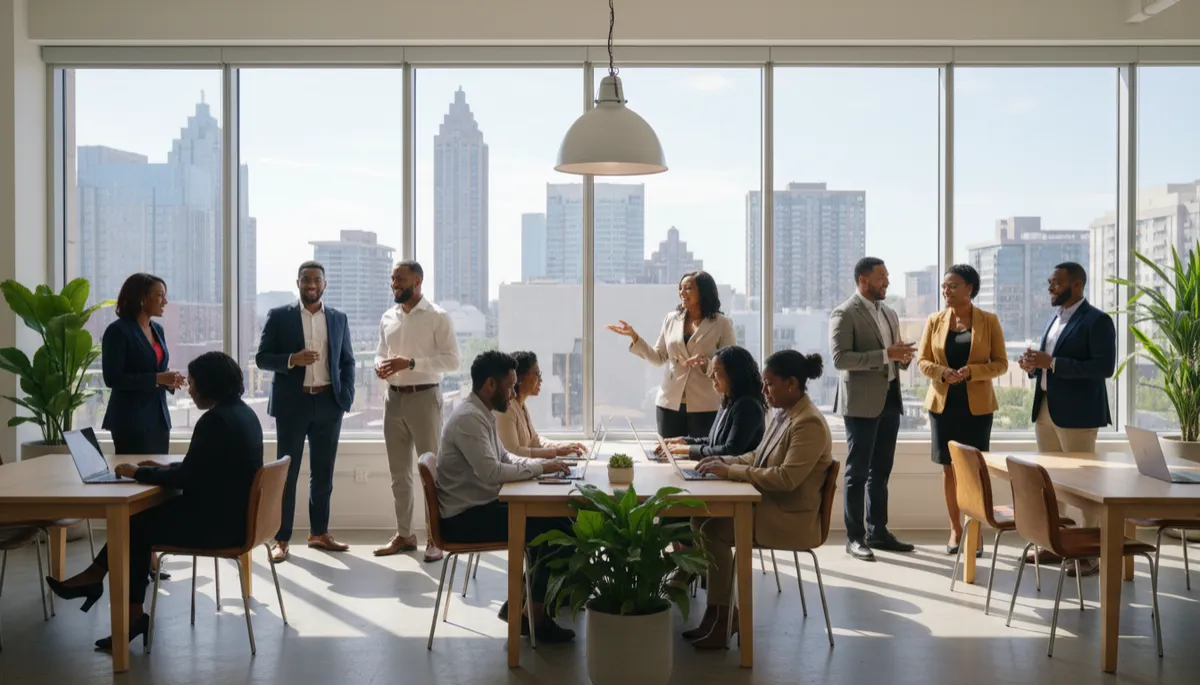
If there is one city in America where Black economic power is most concentrated, most visible, and most organized, it is Atlanta. The city is home to the largest concentration of Black middle-class and affluent households in the nation. Black-owned businesses line the corridors of Cascade Road, Bankhead Highway, and the West End. Black entrepreneurs have built empires in media, real estate, entertainment, healthcare, and technology right here.
Atlanta's Black business community is not merely participating in the economy — it is leading it. Companies like Tyler Perry Studios have transformed a former military base into a global entertainment hub. Black chefs and restaurateurs have made Atlanta a culinary destination. Black real estate developers are building communities while fighting displacement in historically Black neighborhoods like Vine City, Pittsburgh, and the Old Fourth Ward. The energy in Atlanta is real, and it is scalable.
Young Black Consumers Are Reshaping the Future
The National Urban League's report highlights younger Black consumers as a driving force behind the next generation of economic growth. Black millennials and Gen Z are not passive consumers — they are entrepreneurs, content creators, investors, and digital innovators building their own economic ecosystems.
Black-owned fintech platforms are democratizing investment. Black content creators are building media empires with hundreds of millions of followers. Black fashion entrepreneurs are competing at the highest levels. Black food innovators are bringing soul food, Caribbean cuisine, West African recipes, and plant-based cooking to mainstream audiences — on their own terms and with their own equity. This younger generation understands that it is not enough to make money. You have to build institutions, own intellectual property, and create generational wealth.
How to Put Your Power to Work
Economic power is only as strong as our willingness to use it with intention. Here are specific ways every Black Atlantean can put their buying power to work today:
Support Black-owned businesses first. Before ordering on a major app, check if a Black-owned restaurant delivers in your area. Before shopping at a chain, check if there's a Black-owned boutique that carries it. The Official Black Wall Street app and the Support Black Owned directory make this easier than ever.
Hold corporations accountable. When a company retreats from DEI, say something publicly. When a company maintains its commitments to Black employees and communities, reward them with your business and your voice on social media.
Invest in Black banks and credit unions. Citizens Trust Bank and other Black financial institutions keep capital within the community. Every deposit is capital that can be lent to Black homebuyers and Black business owners.
Build, don't just buy. The most powerful use of Black buying power is starting and growing Black businesses. Atlanta's entrepreneurial infrastructure — from the Atlanta Black Chambers to Invest Atlanta small business programs — is there to help you launch and grow.
The Bottom Line
$2.1 trillion is not just a number. It is a declaration of power. Black America has always been economically productive — we built this country with our labor, and now we sustain it with our spending. What is changing in 2026 is the intentionality with which we are claiming and directing that power.
The companies, politicians, and institutions that want our dollars while working against our dignity will learn what Black economic power truly means. And the Black businesses, community organizations, and allies who show up for us will discover what it means to have $2.1 trillion in their corner. Shop Black. Invest Black. Build Black. The power has always been ours.




