Black Mayors Sound the Alarm: Our Votes — and Our Future — Are Under Threat
Black Mayors Sound the Alarm: Our Votes — and Our Future — Are Under Threat
As America paused to celebrate 250 years of independence this summer, a coalition of African American Mayors issued a message that cut through the patriotic pageantry with urgent clarity: our democracy's promise is only as real as every citizen's equal access to the ballot — and for Black Americans, that access is once again under threat.
The African American Mayors Association (AAMA) — the only organization exclusively representing African American elected mayors in the United States — published a powerful call to action on August 8, 2026, authored by elected officials who govern communities from Georgia to Alabama to Florida.
Who Is Speaking — and Why It Matters
Among the signatories are mayors who lead communities in the Deep South, where the legacy of voter suppression is not ancient history — it is living memory. They include:
- Mayor Vince R. Williams — Union City, Georgia
- Mayor Van R. Johnson, Jr. — Savannah, Georgia
- Mayor Steven Reed — Montgomery, Alabama — the city where Rosa Parks refused to give up her seat and where the Selma-to-Montgomery marches began
- Mayor Alix Desulme — North Miami, Florida
- Mayor Phillip Jones — Newport News, Virginia
These are not political pundits. These are elected leaders who are watching the erosion of voting rights happen in real time — in their own districts, among their own constituents.
What Is Being Threatened
The warning from Black mayors is backed by documented policy shifts:
- New voting barriers in Congress: Legislation proposing stricter voter ID requirements, reduced early voting windows, and restrictions on absentee ballots is advancing at the federal level — measures that disproportionately impact Black, Latino, and low-income voters.
- A critical Supreme Court decision: A recent ruling is expected to reduce the number of majority-minority congressional districts, potentially cutting the number of nonwhite members of Congress — diluting Black political representation for a generation.
- A $20 million mobilization campaign: In response, civil rights and advocacy organizations have announced a $20 million campaign to mobilize Black voters, educate communities about their rights, and counter voter suppression efforts at every level.
- Weakened federal enforcement: The agencies and executive structures that once enforced the Voting Rights Act and monitored election integrity in historically suppressed communities have been dramatically weakened or restructured.
What Georgia's History Teaches Us
Georgia holds a particular lesson for this moment. In 2020 and 2021, Black Atlanteans — alongside Black voters across the state — did something extraordinary. They organized, mobilized, and turned Georgia into a battleground state that delivered two U.S. Senate seats and a presidential victory. That political earthquake was the result of years of grassroots organizing, community investment, and relentless voter registration work.
The response was immediate: Georgia enacted Senate Bill 202 in 2021, rolling back many of the voting access measures that had made those historic wins possible. Drop boxes were limited. Early voting rules changed. Even giving water to voters waiting in line was criminalized.
What happened in Georgia is happening nationally now — and it is a preview of what's at stake if Black voters disengage.
The Mayors' Message Is Clear
In their August 8 statement, the African American Mayors Association delivered a message that every Black Atlantean should hear:
As we look toward the next 250 years, one of the most patriotic things any of us can do is simple: learn our rights, show up for one another, and vote like our future depends on it.
Because it does.
What You Can Do Right Now
The fight for Black voting rights is not abstract. It happens in courtrooms, in statehouses, and at polling places — and it needs you:
- Check your voter registration today. Purges happen. Addresses change. Make sure you're on the rolls and your information is current.
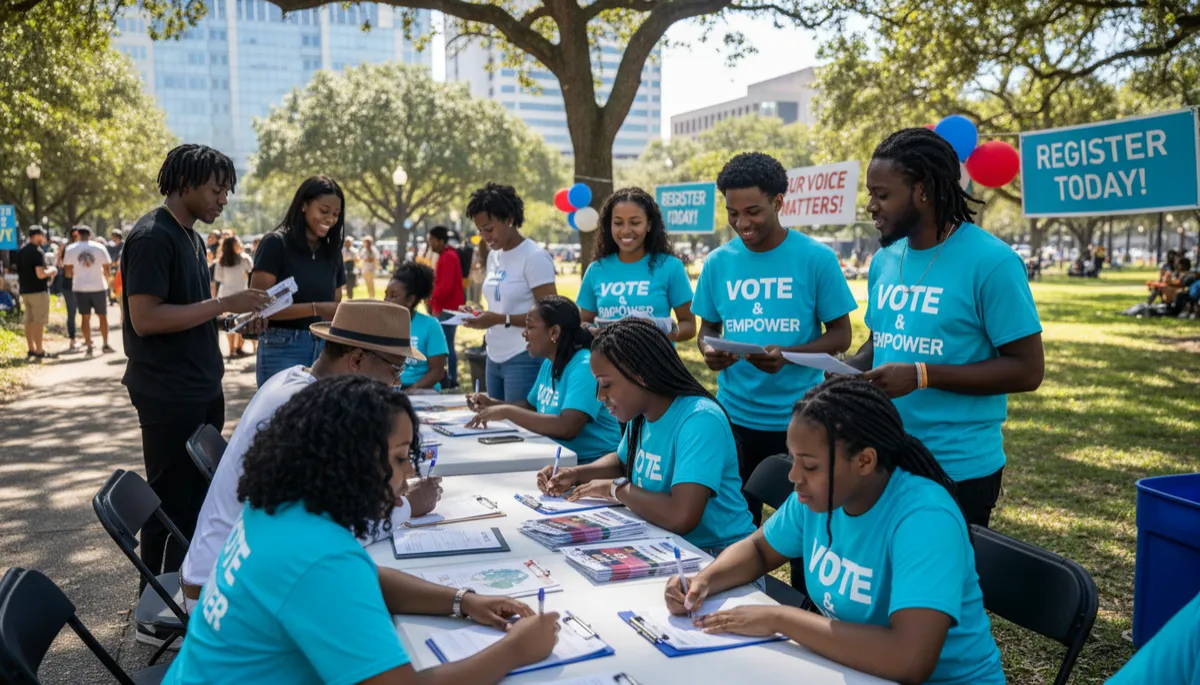
- Register others. Host a voter registration drive in your church, barbershop, salon, or workplace. Every new registrant is a new voice.
- Know your rights at the polls. If you're in line before the polls close, you have the right to vote. If you're told you can't vote, ask for a provisional ballot. Know the law.
- Support voting rights organizations financially and with your time. Legal challenges to voter suppression laws need resources.
- Show up in November and every election after. Local elections — school boards, city councils, judgeships — are where policy is made closest to home. They matter enormously.
Freedom, as the mayors remind us, does not happen in a vacuum. It must be protected, reinforced, and renewed — by us, every single day.
Register. Organize. Vote. Our future is on the line.




