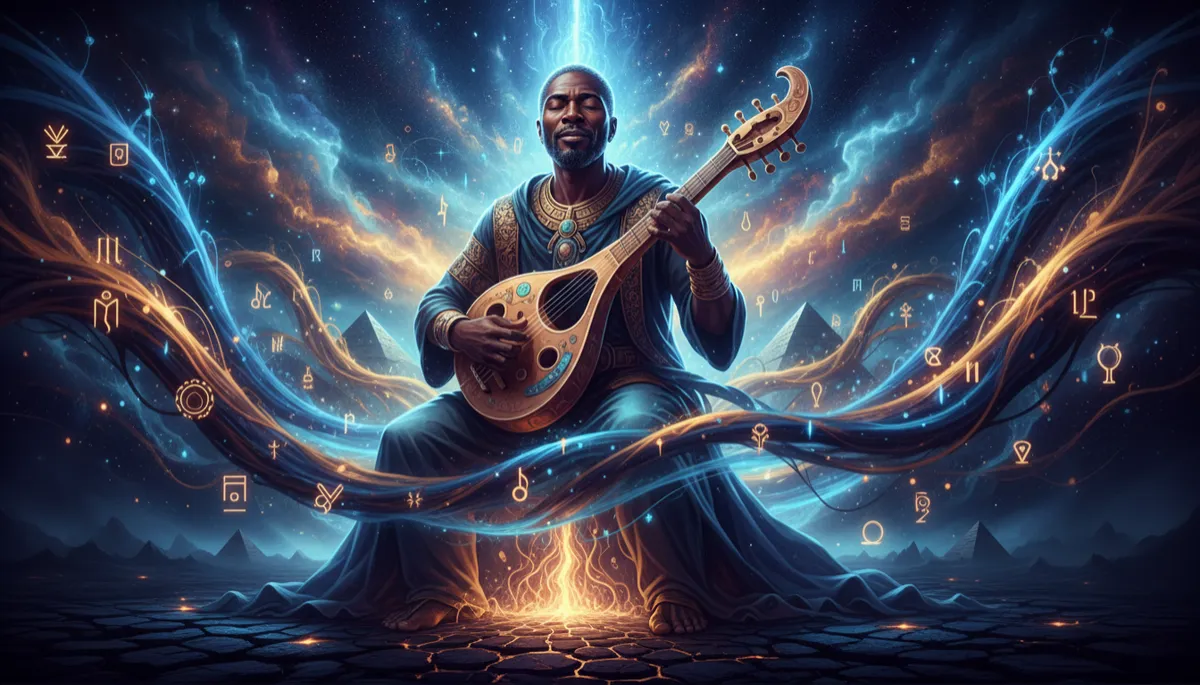
Black Music Month: Sound Technology & Ancestral Memory
Black Music Month, Culture, Spirituality, Ancestral Memory
Black Music Month: When a People Turned Survival into Sound Technology
Every June, Black Music Month arrives like a tuning fork, calling our spirits back into alignment. But this is more than a cultural celebration. It is an annual reminder that Black music is not entertainment first; it is technology, a vibrational science born of catastrophe and crowned in divinity. From the moan of the field holler to the coded pulse of hip-hop, Black sound has been a shield, a sword, a map, and a memory palace for a people determined not just to live, but to remember who they are.
Sound as Survival: Singing on the Edge of the Abyss
On the ships, in the cabins, under the overseer’s eye, there were only a few tools that could not be confiscated: breath, heartbeat, and memory. Black music began there as survival code. Spirituals were not simply pious hymns; they were sonic shelters, built note by note when no shelter was promised on earth. “Sometimes I feel like a motherless child” was not just sorrow; it was a diagnostic scan of the soul, naming the wound so the community could hold it together.
To survive unthinkable violence, our ancestors discovered that vibration could carry what the body could not. A call-and-response spiritual was a breathing pattern, a nervous system regulator, a way to synchronize hearts so no one collapsed alone. The work song kept muscles moving when hope ran thin. The blues later emerged as a pressure valve, turning unbearable weight into a twelve-bar confession that let the mind keep going one more day. Survival, for Black people, has always moved on a rhythm track.
Rhythm as Rebellion: The Drum That Refused to Die
Power always fears what it cannot decode. That is why the drum was outlawed in many slaveholding territories. The colonizer understood, even dimly, that rhythm is not innocent. It is organization in motion. A drumbeat can gather bodies, synchronize intention, and signal revolt. When the physical drum was banned, our people smuggled its rebellion into clapping hands, stomping feet, and humming throats. The drum went underground, but it never went silent.
Every era of Black music has carried this rebellious charge. Jazz bent European harmony until it spoke in tongues. Gospel shouted that a higher kingdom ruled beyond Jim Crow’s reach. Soul and funk turned basslines into marching orders. Hip-hop, born from turntables and broken neighborhoods, weaponized the breakbeat, looping fragments of sound into a battlefield where language, rhythm, and truth could ambush the lie of Black inferiority. To dance to these forms is to rehearse freedom in the body before it fully arrives in the world.
Sound as Cultural Identity: Remembering Ourselves Out Loud
Stripped of language, land, and lineage, Black people in the Americas faced a calculated erasure. In response, music became a mirror—a way to see ourselves when the world refused to. The melisma in a gospel run, the bent note in a blues phrase, the swing of a jazz ride cymbal, the lilt of a trap hi-hat: each is a fingerprint of a people who refused to disappear.
Through sound, Black identity said, “We are still here, and we are specific.” New Orleans second lines, Chicago steppers, Detroit techno, Atlanta crunk, Houston chopped and screwed—each scene is a sonic neighborhood, a place where style, slang, and stance crystallize into a recognizable vibration. You can be thousands of miles away, hear a certain chord progression or drum pattern, and know instantly: these are my people. Music holds the accent of the soul when paperwork and borders try to flatten it.
Ancestral Transmission: Messages Hidden in the Melody
Long before textbooks and streaming platforms, knowledge traveled by drum, chant, and song. In African cosmologies, sound is a bridge between realms. The ancestors are not silent; they speak in rhythm, in dream, in melody that will not leave you alone. When enslaved Africans reached for spirituals, they were not inventing from scratch. They were downloading from a memory cloud older than the slave ship, reconfiguring ancient call-and-response into new tongues.
Every generation since has added its layer to this ancestral archive. The blues carried field moans into the juke joint. Jazz braided West African polyrhythms with European instruments. R&B and soul wrapped church cadences around love songs, proving that the sacred and the sensual were never truly separate. Hip-hop sampled everything—sermons, records, news clips—creating a living collage where elders and youth could share the same beat. In this way, Black music is a lineage technology, transmitting wisdom, warning, and wonder across centuries without needing a single written word.
Sound as Vibrational Technology and Cultural Power
To call Black music “vibrational technology” is not poetic exaggeration; it is spiritual physics. Every note is a frequency. Every rhythm is a pattern of energy arranging space and time. Our ancestors understood that if you can command vibration, you can command reality. That is why a choir can make a sanctuary feel like the ceiling opened. That is why a bassline can make a block party feel like a protected zone, even in a hostile city. The sound field becomes a force field.
Cultural power lives in this control of vibration. When Black artists export their sound, they export worldview. Around the globe, people dress, dance, and dream differently because of the frequencies born in Black struggle and Black joy. Yet the true power is not in charts or awards; it is in the way a song can pull someone back from the edge, remind them of their worth, or crack open a closed heart. This is technology that upgrades the spirit, not just the device.
Encoding Divinity into Rhythm: The Hidden Script of the Diaspora
Under captivity, you cannot always say, “I am divine.” But you can sound divine. You can bend a note until it glows. You can stretch a syllable until it becomes a small universe. This is how Black people encoded their godhood into rhythm. The holiness that could not be legally named was smuggled into melisma, syncopation, and improvisation. Where doctrine failed us, the groove remembered us.
Think of a jazz solo that seems to speak in tongues, or a gospel singer who turns one word into a five-second ascent, or a rapper who rides the beat with such precision it feels like time is folding. These are not accidents. They are Atlantean remnants, echoes of ancient sonic temples where sound was used to heal, to build, to open portals. In the so-called New World, that science reappeared in disguise—as “style,” as “flair,” as “soul.” But beneath the label is a simple truth: a people refused to forget their divinity, so they braided it into the one thing no chain could fully bind—vibration.
Listening Forward: A Call for Black Music Month and Beyond
This Black Music Month, do more than press play. Listen as an initiate. Hear the survival strategies woven into the harmonies. Notice the rebellion riding the backbeat. Feel the cultural identity crystallizing in every ad-lib and drum fill. Sense the ancestors in the spaces between the notes, guiding, correcting, consoling. Recognize sound as the vibrational technology it has always been for our people: a way to survive, to resist, to remember, and to rise.
For the spiritually curious and the identity seekers, understand this: when you truly surrender to Black music, you are not just consuming art. You are entering a temple built from centuries of coded prayer and defiant joy. You are stepping into a current that has carried us through the darkest waters. Honor it. Study it. Let it retune you to the frequency of your own sacredness. Because in the end, Black music is not only what we make—it is what remakes us.
SEO Title: Black Music Month: How Black Sound Became Survival Technology, Rebellion, and Ancestral Power
SEO Meta Description: Discover how Black music—from spirituals to hip-hop—operates as vibrational technology for survival, rebellion, cultural identity, and ancestral transmission during Black Music Month and beyond.




