She Built What the System Wouldn't: Howard Student's 'Deadlining' Database Puts Missing Black Women and Girls on the Record
By Thomas | Black Atlanteans
One question from a freshman history paper turned into a public record that Washington, D.C. never built for itself. Here is the story of Deadlining, and why it should matter to every one of us.
The Story: A 6-Year-Old Girl, a 1961 Disappearance and a Student Who Refused to Look Away
While researching a history paper in her freshman year, Howard University student Avery Bernard Johns came across an unsolved case: Hattie Yvonne Jackson, a 6-year-old Black girl who was abducted by an unidentified white man while playing in D.C.'s Rock Creek Park in 1961, according to the Howard University News Service. She has been missing ever since. Johns was haunted by a line in a 1963 Evening Star article noting that there were days, perhaps weeks, when only a few people thought of Hattie.
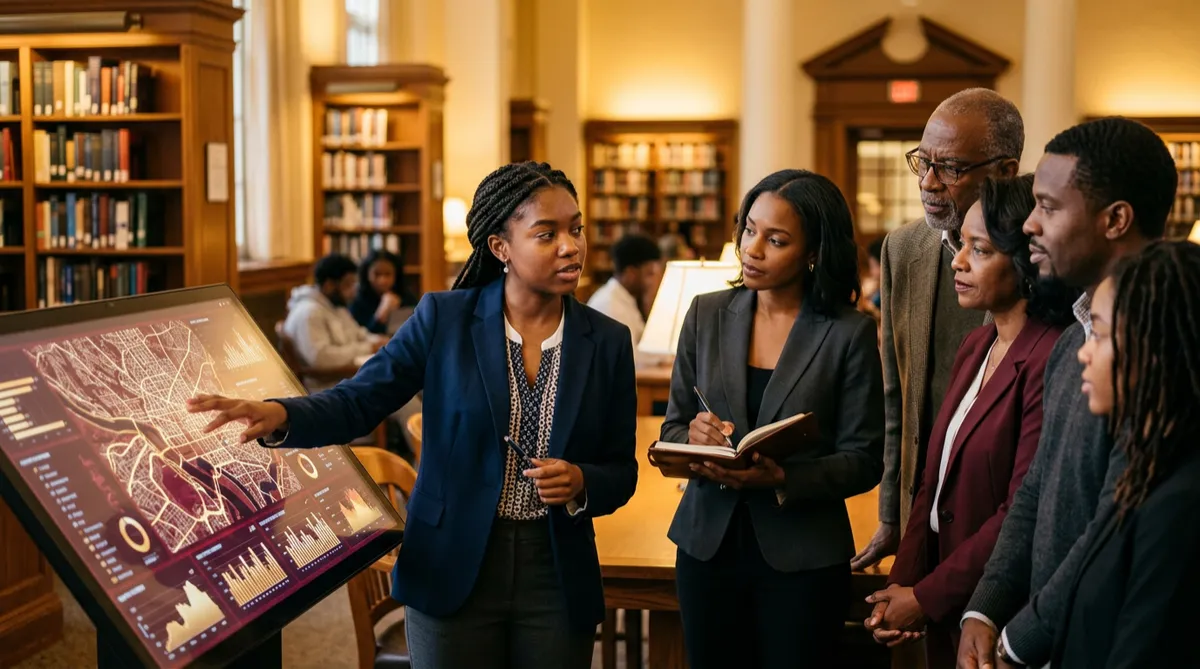
Johns, now a junior double majoring in history and sociology with minors in data science and criminology, tried to advance the case but found very little information to work with. So she built what did not exist. The result is Deadlining, a public database that, according to Black Enterprise and The New Hampshire, documents 186 cases of missing and murdered Black women and girls in Washington, D.C., from 1961 through 2025.
What Happened: Facts From the Reporting
- The records were scattered. Black Enterprise reports that missing-person cases can be hard to investigate when records are spread across government agencies, newspaper archives and other sources. Johns's first search through federal missing-person records turned up just 37 cases, before further research expanded the database to 186. The Howard University News Service reports that most of what she found on Hattie's case came from archival newspapers rather than law enforcement records, and Black Enterprise reports she discovered that some older police records had been discarded.
- She taught herself to code. “This could just be publicly available information, but no one in the government is doing it,” Johns told the Howard University News Service. “I knew that I could do it, so I taught myself how to code.”
- It offers more than a list. Deadlining includes a searchable database, an interactive map and geospatial analysis that, per the Howard University News Service, the D.C. Missing Persons website does not offer. Johns also looks at historical redlining, transportation infrastructure and neighborhood development in relation to patterns of violence and disappearances, The New Hampshire reports.
- The work is being shared. The New Hampshire reports Johns presented Deadlining on October 1 at the University of New Hampshire's Justice Studies Fall 2026 Colloquium. The Howard University News Service notes she also presented at the Massachusetts Institute of Technology last semester.
Why It Matters to Black America
Johns says she noticed cases of missing Black women seemingly concentrating in increasingly gentrified, heavily policed areas with shrinking Black populations. Henderson Long, a licensed private investigator and CEO of D.C.'s Missing Voice Inc., told the Howard University News Service that he has observed an overrepresentation of victims from Wards 7 and 8 in the District's missing cases.
The Howard University News Service also cites the Violence Policy Center: Black women make up about 14% of the female population in the U.S., but accounted for 31.4% of women killed by men in single victim/single offender cases in 2023. On missing persons nationally, Black Enterprise reports, citing the FBI's 2025 missing-person statistics, that roughly 96,000 missing-person entries involved Black females, with nearly four in five involving girls under 18. Black Enterprise is careful to note those figures count records entered during the year, not necessarily unique individuals or unresolved disappearances.
Johns, asked at MIT why she focuses only on Black women, was direct. “It’s not exclusionary — it’s equitable,” she said. She described Black women as often hypervisible as suspects and hyperinvisible as victims. Sociologist Cheryl L. Neely, in her 2015 book on media, police and the invisibility of Black women as homicide victims, attributes the gap to systemic neglect, as quoted by the Howard University News Service.
Why It Matters to All of America
A missing-persons system that depends on scattered files, discarded records and a student volunteer to piece together six decades of cases is a public-safety problem, not only a Black one. Better record-keeping, public data and community partnership help families find answers, and they help every neighborhood hold institutions accountable. Henderson Long's own family waited from September 1999 until January 2019 for the remains of his aunt, Allean Logan, to be identified, and he called being left in the dark “devastating.” “You can’t do any of this alone,” Long said.
Community Voices
“My work started off rooted around the Howard community because I recognized there was a specific problem in D.C. But there’s a problem everywhere.” — Avery Bernard Johns, Howard University News Service
“If I have the right to be alive, I want to use my vitality to help these women.” — Avery Bernard Johns, Howard University News Service
How We Can Make Things Better: Practical Steps
- Know the cases. Explore the Deadlining database and share the names and stories of missing Black women and girls. Visibility is where help starts.
- Support local missing-persons nonprofits. Groups like Missing Voice Inc. in D.C. and the Black & Missing Foundation work on behalf of families. Volunteer, donate or amplify their alerts.
- Request records. Black Enterprise notes the Metropolitan Police Department has a Freedom of Information Act process for requesting records. Journalists, students and families can use it, and local residents can ask their own police departments how records are kept and for how long.
- Ask your officials direct questions. How are missing-person cases tracked in our city? Are records preserved? How are cases involving Black women and girls handled? Show up to council and community safety meetings and ask.
- Support student researchers. Johns says research and activism do not require extensive professional experience. Fund, mentor and cite young Black scholars doing this work, especially at HBCUs.
- Check on each other. If someone you know goes missing, contact local law enforcement and trusted community organizations right away, and share only verified information from the family or police so searches are not derailed.
Sources
- Howard University News Service (The Hilltop): “Howard Student’s Database Spotlights Missing And Murdered Black Women In D.C.,” Oct. 13, 2026
- Black Enterprise: “‘Deadlining,’ A Howard University Student’s Research Highlights Gaps In Missing Black Women’s Case Records,” Oct. 16, 2026
- The New Hampshire: “Howard University student highlights missing and murdered Black women in Justice Studies colloquium,” Oct. 2026
Statistics and quotes above are attributed to the outlets that reported them; early figures can change as more records are reviewed.
Sign-off: A 20-year-old with a laptop and a library card did what institutions had not. Let that be our reminder that our people are worth counting, and that we are not powerless to do the counting. Stay informed, stay loved, and keep looking out for one another. — Thomas, Black Atlanteans


