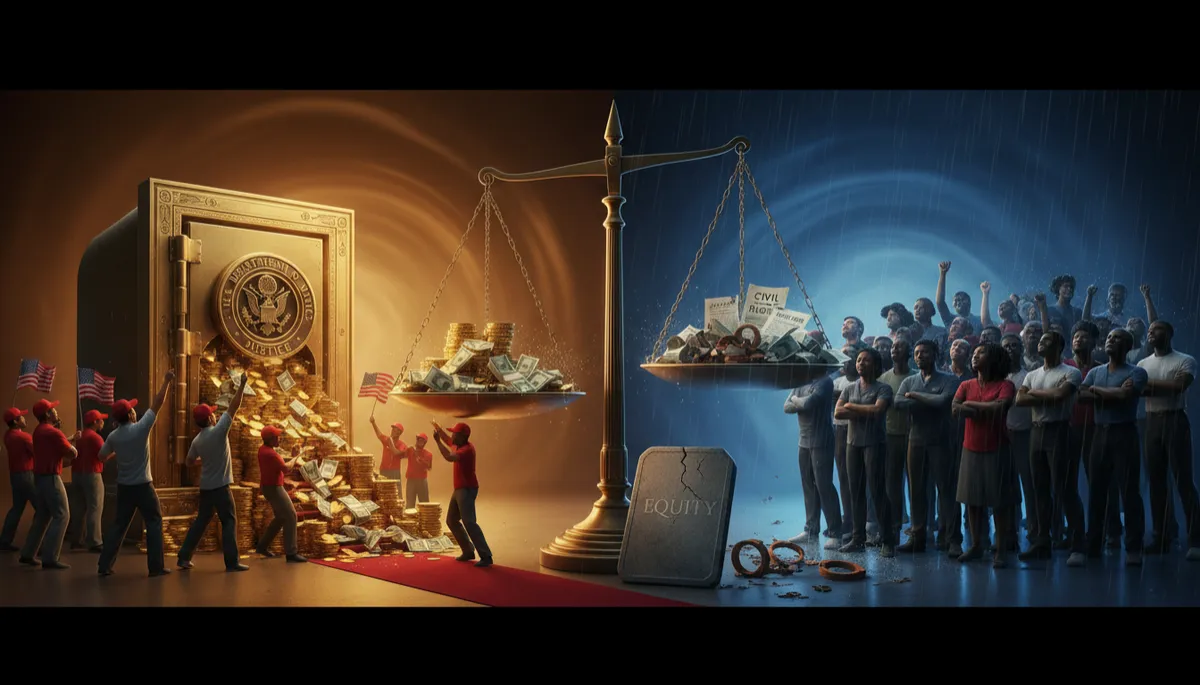
DOJ's $1.8 Billion Trump Supporter Fund Exposes a Two-Tier Justice System
Politics, Justice System, Civil Rights
DOJ’s $1.8 Billion Trump Supporter Fund Exposes a Two‑Tier Justice System
The Justice Department’s announcement of a nearly $1.8 billion fund to compensate Trump supporters who say they were wrongly prosecuted is not just another headline. It is a flashing red siren about who this system bends over backward to protect—and who it routinely sacrifices.
A Payout Pipeline for One Political Base
According to the announcement, the nearly $1.8 billion fund is designed to compensate Trump supporters who claim they were wrongly prosecuted or “targeted” under previous administrations. This comes as Trump’s DOJ has been dismissing cases against January 6 defendants and reviewing earlier prosecutions tied to his political base. In other words, the department is signaling that if you are aligned with the right politician, the government will not only clear your record—it may cut you a check for your trouble.
This is not neutral justice. It is a textbook example of political favoritism in a system already under fire for bias. Recent debates about “weaponization” of the DOJ have focused on whether one party uses prosecutions to punish opponents. What we are seeing now is the flip side: using federal power and public money to reward loyalists, even those connected to an attack on the Capitol that left people dead and democracy shaken.
One Standard for Trump’s Base, Another for Black America
Contrast this fast‑tracked, billion‑dollar relief effort with how Black Americans are treated when the state gets it wrong. There is no standing multibillion‑dollar federal pot for Black men who spend decades in prison on wrongful convictions. No special fund for families whose loved ones were killed by police, even when video evidence shows excessive force. No sweeping DOJ initiative to compensate communities terrorized by discriminatory stop‑and‑frisk, over‑policing, or racist sentencing practices.
When the Supreme Court weakens the Voting Rights Act or greenlights maps that dilute Black political power, as recent decisions have done, Black communities are told to accept it as “the rule of law.” When civil rights cases stall or die inside the DOJ, we are reminded that change takes time, that the system is complex, that budgets are tight. Yet suddenly, there is political will and nearly $1.8 billion ready to move when the beneficiaries are a president’s supporters who stormed the Capitol or backed those who did.
This is the two‑tier system laid bare: leniency, review, and compensation for a mostly white, pro‑Trump base; scrutiny, delay, and denial for Black communities still waiting on justice for police violence, voter suppression, and civil rights violations that have been documented for generations.
What Black Communities Need to Watch—and Demand
For Black readers, this fund is not just about Trump supporters; it is a case study in how power operates. If the DOJ can mobilize this level of money and urgency for one group, it proves the federal government can act quickly and decisively when it chooses. The question is why it almost never chooses to do so for us.
Community members should be asking hard, specific questions:
- Who qualifies for this fund, and who is being quietly excluded?
- What independent oversight exists to prevent it from becoming a political slush fund?
- Why are there no parallel funds for victims of police misconduct, wrongful convictions, or civil rights violations?
Black communities cannot afford to treat this as distant political drama. These choices set precedents. If the DOJ normalizes paying out one political faction while ignoring long‑standing demands for reparative justice in Black neighborhoods, it locks in the idea that some grievances are worth billions and others are worth press releases and thoughts and prayers.
The Bigger Picture: Power, Not Neutrality
Officials like to insist the justice system is not political. Yet from the Supreme Court’s rollback of voting protections to DOJ decisions that favor one party’s base, the pattern is clear. This fund is not an aberration; it is part of a broader realignment that treats law as a weapon and a reward system, not a shield for the vulnerable.
For Black America, the takeaway is blunt: justice in this country moves fastest for those whose power is being protected. The task ahead is to expose that imbalance, organize against it, and demand that if billions can be found to soothe the grievances of Trump’s base, they can also be found to repair the deep, ongoing harms this system has inflicted on us.




