
Economic Impact of $6 Gas on Working-Class
Fuel Prices, Economy, Working-Class Providers
$6 Gas and Empty Tables: The Quiet Economic War on Working People
California’s gas is now over $6 a gallon while inflation grinds on and restaurant tables sit empty. This is not random hardship. It is a structured economic pressure campaign bearing down hardest on Black working-class men who carry families, communities, and legacies on their backs.
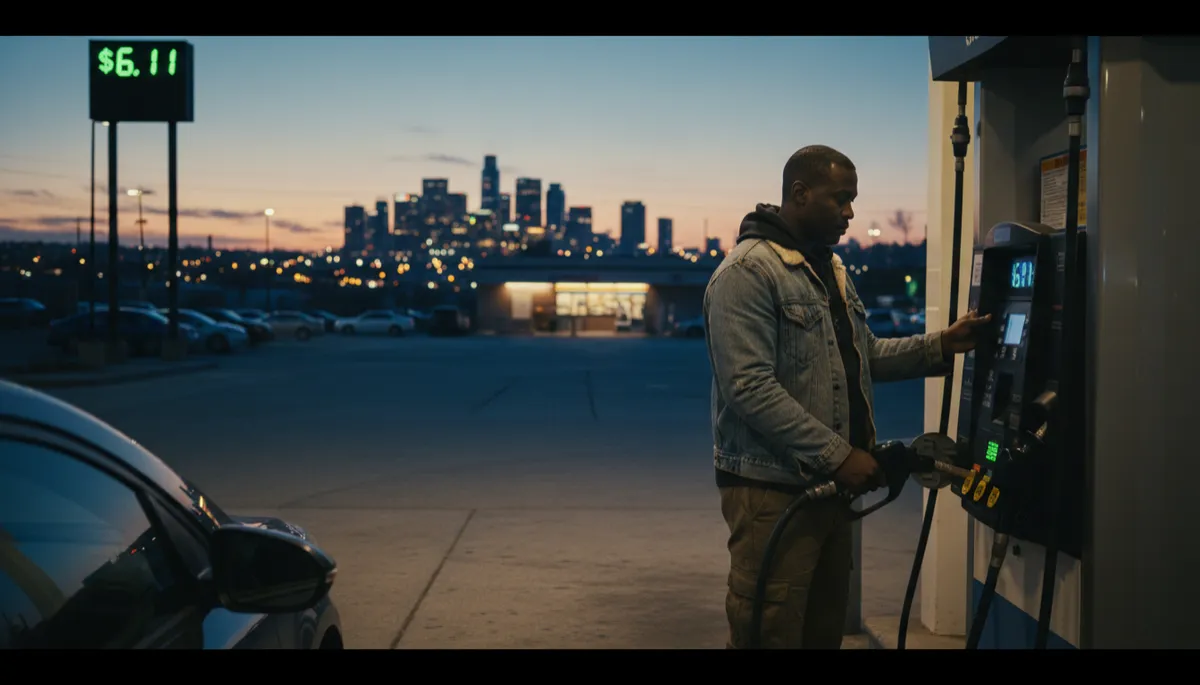
Six Dollars a Gallon: When the Pump Becomes a Battlefield
Gas prices have surged to a 4-year high as tensions in the Middle East continue. Gasoline in California is now over $6 a gallon. Recent data puts regular unleaded at about $6.12 per gallon statewide, with some metro areas like Napa and San Francisco pushing closer to $6.35 per gallon, while the national average hovers around $4.50.
Six dollars a gallon. That's not a statistic — that's a father doing math at the pump before deciding whether to fill the tank or buy groceries. That's a mother rationing miles like she's back on rations. That's working-class America being squeezed from every angle while the architects of that squeeze discuss peace deals from heated offices.
When fuel climbs this high, it is not just “gas.” It is rent, food, child support, medicine, and elder care being quietly taxed through the nozzle. Every commute, every side gig, every visit to a second job now carries a surcharge only the working man pays. The boardroom does not feel this. The block does.
Inflation, Empty Tables, and the Language of “Consumer Anxiety”
Rising prices for gas and other necessities are fueling consumer anxiety as more Americans worry about the long-term effects of inflation. Official numbers estimate inflation running near 3.8% year-over-year, with a sharp 0.6% jump in May alone. On paper, that sounds “moderate.” In the grocery aisle, it feels like theft in slow motion.
"Consumer anxiety" — that's the clean, clinical word for what is actually survival stress. The kind of stress that ages men a decade in two years. The kind that breaks up families not because love died, but because the bills won. The kind that compounds generational trauma in real time.
Americans are increasingly passing up on dining out — so much so that one restaurant in Austin, Texas, is allowing diners to pay whatever they like for their food. Think about that. A restaurant removing prices because the economy has broken spending confidence so thoroughly that the only way to get people in the door is to take the price tag off entirely.
Empty tables are not just about “changing consumer preferences.” They are a mirror: people do not feel safe enough to spend. Wages trail behind prices, rent shadows every paycheck, and fuel drains what remains. Working-class families, especially Black households already hit by wage gaps and wealth gaps, are forced into permanent caution mode.
War Abroad, Pressure at Home: How the Pump Tracks the Battlefield
Reports that the U.S. and Iran were close to a ceasefire deal may have been premature — but oil prices dipped Monday nonetheless, showing how tightly the global war machine is connected to your gas pump. The battlefield is abroad. The bill arrives at your tank.
This is the quiet part they rarely say out loud: every flare-up, every sanction, every “strategic move” in foreign policy can echo directly into the cost of your commute. When energy markets jump, truckers pay more, delivery costs rise, food and goods climb, and the same working man is told to “tighten his belt” in a system already built tight around his neck.
The economy is presented as a mysterious force — but it is a set of choices. Choices about who absorbs risk and who collects reward. In this era, Black providers are asked to absorb risk for everyone: family, employer, and state, while receiving the thinnest margin of safety in return.
What the Elder Knows: You Are Not the Problem, the Design Is
What the elder knows: The provider who cannot afford to provide is not a broken man — he is a man surviving a designed system. The economic pressure on working-class families is not accidental. It is structural. You were never meant to get ahead without knowledge of the system pressing against you. Build wealth literacy. Build alternative income streams. Know that your labor has always been someone else's engine — and your awakening is the only thing that changes the equation.
This moment of $6 gas and empty restaurant tables is a signal, not just a hardship. It tells you that relying on wages alone, on one employer, on one stream of income, is a fragile strategy in a rigged arena. Inflation eats, fuel taxes, and the cost of being poor multiplies every mistake and every delay.
Strategic Moves for the Working-Class Provider
- Track your real cost of movement. Calculate how much each commute, side job, or delivery route costs you at $6+ per gallon. Cut low-value trips. Consolidate errands. Share rides when it protects your time and money, not your pride.
- Shift from consumer to strategist. Study how inflation, interest rates, and fuel prices move together. Free resources from places like the Bureau of Labor Statistics and economic think tanks make the patterns visible, even if the language is dry. Translate that data into decisions about when to lock in leases, refinance, or renegotiate pay.
- Build alternative income streams. A second job is still wage dependence. Look toward skills you can own: trades, digital services, small product runs, consulting, or teaching what you know. Even a few hundred dollars a month from a controlled source is a crack in the system’s grip on your household.
- Practice offensive frugality. Not desperation cutting, but strategic cutting. Cancel what does not move you toward stability or legacy. Re-route that money into debt reduction, emergency savings, and skill-building. Every unnecessary subscription is a quiet leak in your ship.
Legacy in an Unfair Economy
For Black working-class men, legacy is not a luxury topic. It is the difference between your children starting where you started or starting ahead. This economy is not designed to make that easy. But understanding the design is the first act of rebellion.
Fuel prices, inflation, and “consumer confidence” are not abstract charts — they are the levers that decide how many hours you must trade for basic dignity. When those levers move against you, remember: you are not failing. You are being tested by a system that was never neutral.
Stand in that knowledge with the calm of an elder and the resolve of an ancestor. Read the numbers, feel the squeeze, then respond with strategy, not shame. The quiet economic war on working people is real. So is your power to study it, outmaneuver it, and build something that outlives it.




