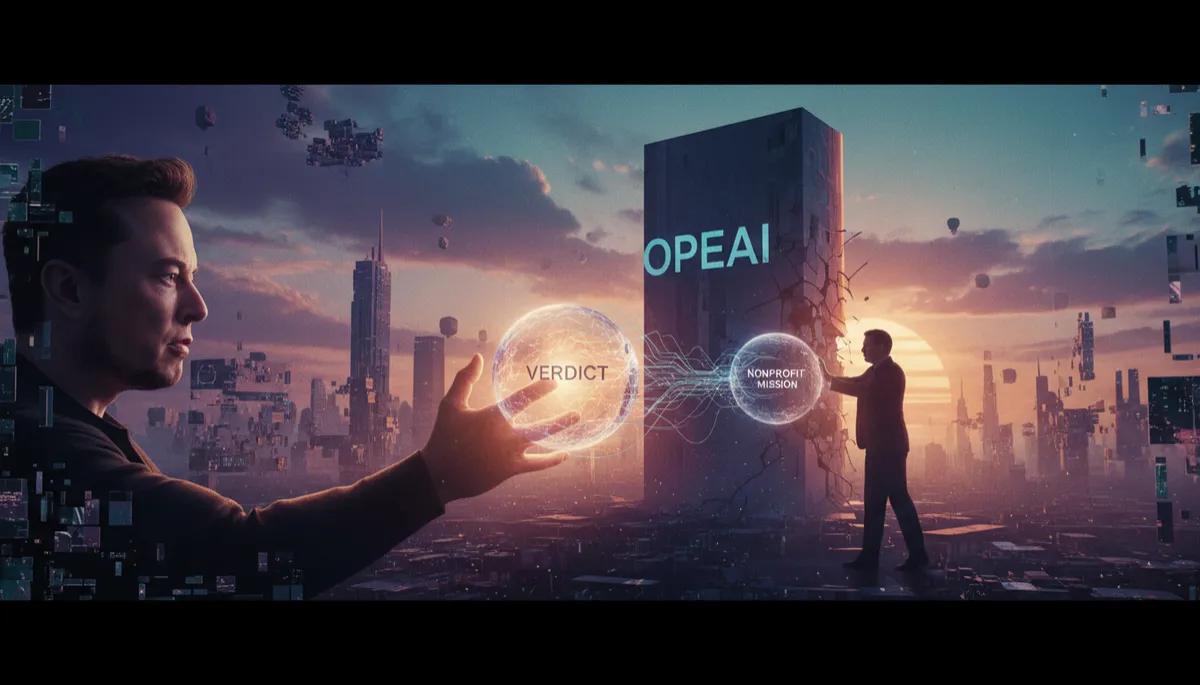
Elon Musk vs OpenAI: Trial Loss Sparks AI Power War
AI, Tech Politics, Elon Musk, Sam Altman, OpenAI
Elon Musk Calls OpenAI Trial Loss a “Technicality” — And Escalates the AI Power War
A federal jury just shut down Elon Musk’s lawsuit against OpenAI. He’s already framing it as a calendar error, not a defeat — and promising an appeal that keeps his power struggle with Sam Altman very much alive.
A Three-Week Trial, Dismissed in Under Two Hours
On May 18, 2026, a federal jury in Oakland needed less than two hours to end Elon Musk’s high-profile trial against OpenAI, Sam Altman, Greg Brockman, and Microsoft. After three weeks of testimony, internal emails, and high-stakes rhetoric, the jury landed on a blunt conclusion: Musk’s trial was dead on arrival because he sued too late. His claims were barred by the statute of limitations, not by some grand vindication of OpenAI’s behavior (Axios, AP).
Judge Yvonne Gonzalez Rogers accepted the jury’s advisory verdict and dismissed every one of Musk’s claims. The message from the court was simple: whatever you think about OpenAI’s evolution from idealistic nonprofit mission to tightly coupled for-profit engine, Musk waited too long to complain in court (Washington Post).
Musk’s Spin: “Calendar Technicality,” Not a Real Loss
Musk wasted no time reframing the outcome. According to reporting from The Guardian, he took to X to argue that the ruling hinged on a “calendar technicality,” not on whether OpenAI betrayed its founding principles. In his narrative, the court dodged the real question: did Sam Altman and the board hijack a charity and turn it into a profit-maximizing AI juggernaut?
That framing matters. To a tech- and AI-aware audience, Musk isn’t just licking his wounds. He’s trying to delegitimize the verdict while keeping his core allegation alive: that OpenAI abandoned its duty to ensure AGI benefits “all of humanity” and instead aligned itself tightly with Microsoft and Wall Street expectations. Calling the verdict a “technicality” is a way to say, the system blinked, but I’m still right.
One Word from Musk’s Lawyer: “Appeal”
Musk’s legal team isn’t pretending this is over. After the verdict, his lead counsel Marc Toberoff summed up their next move in a single word: “Appeal.” TechCrunch reports that Musk intends to take the case to the Ninth Circuit, despite the judge warning that he faces an “uphill battle” because the statute-of-limitations finding was largely factual, not purely legal (TechCrunch, Ars Technica).
Appeals courts rarely second-guess juries on factual timelines. To win, Musk’s team likely has to argue that the lower court misapplied discovery rules — that he couldn’t reasonably have known the full extent of OpenAI’s for-profit pivot until later. That’s a narrow path. But the point of the appeal isn’t just legal victory. It’s to keep the spotlight on what Musk calls a “stolen charity” and to prolong the narrative that OpenAI’s leadership can’t be trusted with AGI-scale power.
The Power Struggle Behind the Lawsuit
Strip away the legal jargon and this is less about filing deadlines and more about an AI power war between two very different visions of the future. On one side, Elon Musk, who co-founded OpenAI, now positions himself as an external watchdog claiming the organization betrayed its original nonprofit mission. On the other, Sam Altman, who turned OpenAI into the world’s most influential AI lab and is reportedly steering it toward a massive IPO (Le Monde).
Musk’s lawsuit sought up to $134 billion in damages and even the removal of Altman as CEO (Axios). That’s not about principle alone; that’s about control. If Musk had won, he wouldn’t just have recaptured the moral high ground. He would have kneecapped a direct rival in the race to deploy and monetize frontier AI systems at scale.
Nonprofit Mission vs. Commercial Reality
For anyone following AI closely, the core tension is obvious: OpenAI’s founding documents promised a nonprofit focused on broad human benefit. The current reality is a capped-profit structure, tight integration with Microsoft, and aggressive commercialization of models that shape everything from coding workflows to media, education, and national security debates. The trial dragged that contradiction into the open, even if the verdict dodged it on procedural grounds.
OpenAI’s defense leaned hard on the idea that Musk knew about — and at times pushed for — a for-profit pivot years ago (Axios). They framed his lawsuit as competitive retaliation, not moral outrage, pointing to pre-trial settlement messages where Musk warned of reputational fallout if the fight continued (Forbes). In other words: this isn’t a crusade; it’s a turf war.
What This Means for OpenAI — and for Everyone Using Its Models
Legally, OpenAI just cleared a major obstacle on the road to a likely late-2026 or early-2027 IPO. The statute-of-limitations verdict stabilizes its position with investors and partners. No $134 billion damages risk. No court-ordered leadership decapitation. The company can keep shipping models, signing enterprise deals, and lobbying regulators from a position of strength.
But for tech and AI-aware readers, the bigger story is what the trial exposed: the fragility of “for the good of humanity” language once real money and real power show up. Musk lost this round, yet his critique of OpenAI’s drift from its nonprofit mission won’t disappear on appeal, win or lose. It will keep resurfacing every time OpenAI pushes a new frontier model, tightens access, or leans further into monetization.
The AI Power War Isn’t Over
Musk calling the verdict a “technicality” and vowing to appeal is not just ego management. It’s a signal that the AI power war between him and Sam Altman will stay in the foreground — in courts, on X, in boardrooms, and eventually in regulation. The jury shut down his lawsuit, but it didn’t resolve the underlying question that matters to anyone building on or competing with OpenAI: who gets to steer the most powerful AI systems on the planet, and on whose terms?
The court answered a narrow legal question about timing. The broader fight — over governance, profit, control, and the future of AGI — is still wide open.




