
Georgia HB 369 Targets Black Women DAs
Atlanta News, Politics, Voting Rights
Georgia’s HB 369 Puts Black Women DAs — and Black Voters — in the Crosshairs
A new Georgia law, HB 369, quietly rewrites how powerful county offices are elected in five Metro Atlanta counties — and every one of those counties is led by a Black woman district attorney. Now, with lawsuits filed and community organizers mobilizing, Black voters are being called to defend both their votes and their vision for justice in Atlanta.
What Georgia HB 369 Actually Does
On paper, Georgia HB 369 is about “nonpartisan elections.” In practice, it reshapes political power in Metro Atlanta’s largest, Blackest counties. Signed by Governor Brian Kemp in May 2026, the law forces certain countywide offices in Clayton, Cobb, DeKalb, Fulton, and Gwinnett to be elected without party labels starting in 2028. That includes the offices of district attorney, county commission, tax commissioner, and others (Ballotpedia).
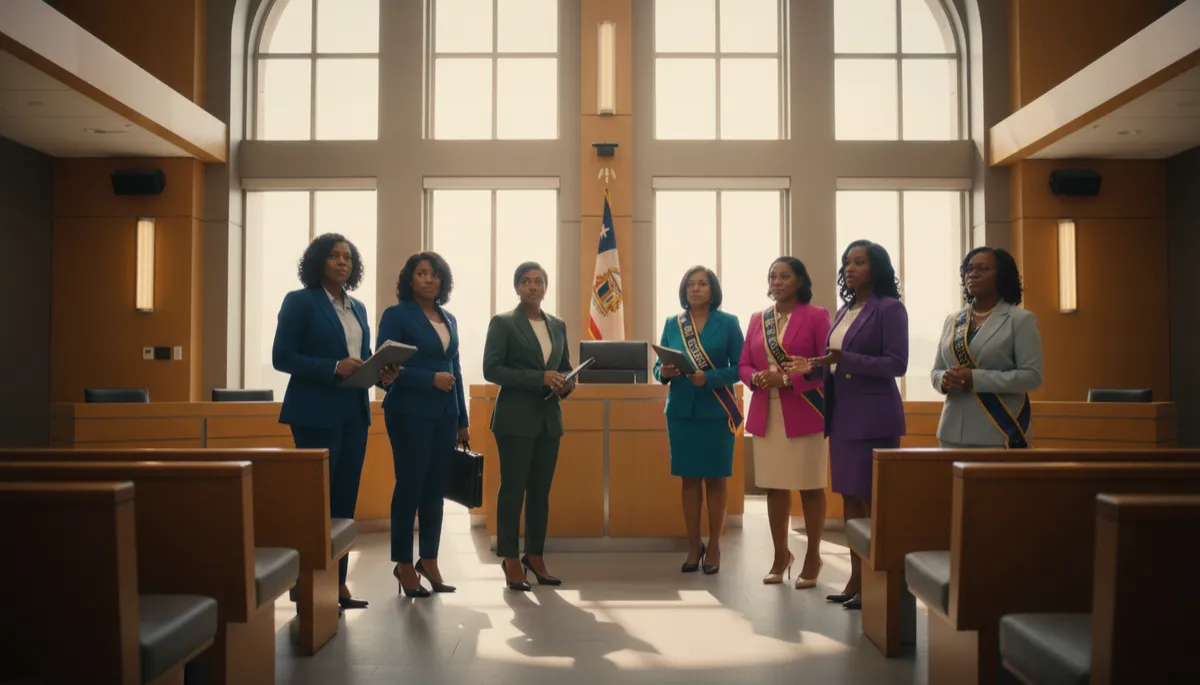
Those five counties share two key traits: they are home to large Black populations and are central to Democratic power in Georgia. They are also home to five Black women DAs: Fani Willis (Fulton), Sherry Boston (DeKalb), Patsy Austin-Gatson (Gwinnett), Sonya Allen (Cobb), and Tasha Mosley (Clayton). HB 369 does not apply statewide. It does not touch majority-white rural counties. It focuses squarely on Metro Atlanta.
How a Vehicle Bill Became an Atlanta Law Power Play
HB 369 didn’t even start as an elections bill. The original version dealt with motor vehicles and food trucks, setting equipment standards like signal arms and warning signs (Georgia General Assembly). In the Senate, lawmakers used a substitute to strip out that language and replace it with a new plan: make key county offices nonpartisan, but only in a handful of Metro Atlanta counties (LegiScan).
The bill passed the Senate 32–21 and the House 93–64 before being signed into law as Act 710. Its nonpartisan provisions kick in on January 1, 2028, just in time for the next round of DA and countywide elections in Metro Atlanta. Campaigns will be forced to run without the “Democrat” label that has helped Black voters quickly identify candidates who align with their values on criminal justice, voting rights, and civil rights.
The Lawsuits: Legal Arguments Against HB 369
Two of the five Black women DAs have taken the fight to court. On June 3, 2026, DeKalb County DA Sherry Boston filed a lawsuit in Fulton County Superior Court challenging HB 369 (Democracy Docket complaint). Standing beside her were fellow prosecutors Fani Willis, Sonya Allen, and Tasha Mosley, all voicing support for the challenge (GPB News).
Boston is the sole named plaintiff, but the lawsuit’s arguments speak directly to Black Atlanta’s stake in this fight. The complaint argues that Georgia HB 369:
- Violates Georgia’s Uniformity Clause by creating special election rules for only five counties instead of applying them statewide, even though the offices are the same type of county positions across Georgia.
- Violates equal protection under the Georgia Constitution and the U.S. Constitution by targeting counties with large Black populations and strong Democratic voting histories, effectively singling out Black voters and Black women DAs for different treatment.
- Violates Georgia’s Rejected Bills Clause because a similar proposal failed earlier in the session, then was revived by gutting and rewriting an unrelated bill without the two-thirds vote the state constitution requires for resurrecting rejected measures.
The state has moved to dismiss the case, and a crucial hearing is scheduled for September 18, 2026 (Democracy Docket). If Boston wins, HB 369 could be struck down, preserving partisan elections in these five counties. If she loses, the new rules will shape who leads Metro Atlanta’s justice system for years to come.
What’s Really at Stake for Black Voters
Supporters of HB 369 claim that nonpartisan elections will “take politics out” of local races. But for Black voters in Atlanta, party labels are not just about partisan identity — they are a shorthand for issues that touch everyday life: police accountability, mass incarceration, bail reform, voting rights, and reproductive justice. Removing the “Democrat” label from the ballot doesn’t remove politics; it removes information that Black voters have long used to protect their interests.
Nonpartisan elections can also tilt power toward those with the most money and name recognition. Without party cues, campaigns become more expensive and more confusing. That can depress turnout and open the door for well-funded challengers backed by statewide or national interests who may not share the priorities of Black communities in South DeKalb, South Fulton, or Gwinnett’s immigrant corridors.
The fact that HB 369 targets the only five counties with Black women DAs sends its own message. These prosecutors have used their power to question the status quo — from charging decisions to diversion programs — and, in the case of Fani Willis, to hold powerful figures to account. Changing the rules midstream looks less like neutral reform and more like retaliation and control.
The Political Context: Why Atlanta Is Ground Zero
HB 369 doesn’t exist in a vacuum. It comes after years of Republican-led efforts at the state level to rein in Metro Atlanta’s political power. From new voting laws to attempts to take over local election boards, the pattern is clear: when Black voters in Atlanta flex their power, the rules of the game get rewritten.
These five counties are the engine of Georgia’s recent political transformation. They helped deliver record turnout in 2020 and 2022, flipping Georgia in presidential and U.S. Senate races. They are also where Black voters, especially Black women, have elected prosecutors who talk openly about reform, not just punishment. Shifting these races to nonpartisan contests in 2028 is about more than ballot design — it is about who gets to define justice in a rapidly changing Georgia.
How Black Atlanta Can Respond
The fight over Georgia HB 369 is happening in courtrooms, but its outcome will be decided in communities. Black Atlanta has responded to attacks on voting rights before — by organizing voter education drives, building local coalitions, and turning out in record numbers even when the rules were designed to confuse and suppress. This moment calls for that same energy, focused not only on statewide races, but on county offices that shape everyday justice.
Between now and 2028, organizers, churches, civic groups, and neighborhood associations will need to educate voters on who their DA is, what that office does, and why equal protection and uniform election rules matter. If HB 369 stands, Black voters can still turn nonpartisan ballots into powerful statements by learning candidates’ records, endorsements, and values — and by refusing to be confused or silenced.
The Road Ahead
Whether the courts strike down HB 369 or allow it to stand, Black Atlanta is once again being asked to do what it has always done: organize, adapt, and lead. The presence of Black women DAs in Fulton, DeKalb, Gwinnett, Cobb, and Clayton is not an accident — it is the result of years of determined voting, advocacy, and community-building. This law is an attempt to blunt that power. The response, as always, will come from the people.
The question now is not just what the courts will decide, but how Black voters in Metro Atlanta will write the next chapter. HB 369 is a reminder that every ballot, every election rule, and every courtroom fight is part of a larger story — one in which Black communities continue to demand not only the right to vote, but the right to have that vote truly respected.




