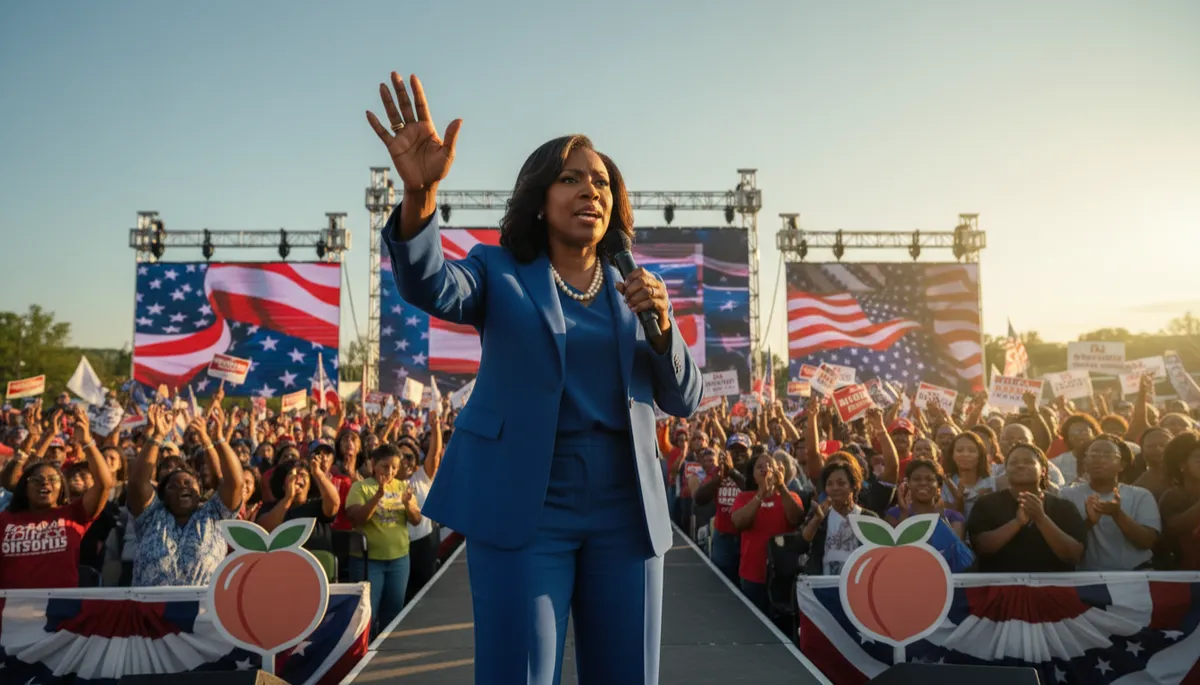
Keisha Lance Bottoms Eyes History as Georgia's First Black Female Governor
Atlanta, GA — When Keisha Lance Bottoms secured the Democratic gubernatorial nomination in Georgia's May 19 primary — clearing the 50 percent threshold without a runoff — she did more than win a political contest. She stepped into the arc of history. If she defeats Republican billionaire Rick Jackson on November 3, 2026, she will become the first Black woman ever to serve as governor of Georgia, and the first Black female governor in the history of the United States.
A Barrier-Breaking Candidacy
Bottoms, 55, is no stranger to firsts. As mayor of Atlanta from 2018 to 2022, she led one of America's most dynamic cities through the COVID-19 pandemic, the 2020 racial justice uprisings, and the national reckoning over policing that followed the murder of George Floyd. She subsequently served as a senior adviser for public engagement in the Biden White House before returning to Georgia to mount this historic gubernatorial campaign.
She is running, she says, to deliver for working families and bring steady leadership to a state navigating the turbulence emanating from Washington. Her platform centers on expanding Medicaid to cover an estimated 300,000 Georgians — including rural communities threatened by hospital closures — ending state income tax for teachers, targeting corporate landlords who have driven up housing costs, and increasing support for small businesses.
Breaking a 28-Year Democratic Drought
The stakes extend beyond representation. Democrats have not won Georgia's governorship in nearly three decades, since Roy Barnes defeated Republican businessman Guy Millner in 1998. Georgia is now considered a swing state at the federal level — demonstrated dramatically by its narrow Biden victory in 2020 and its two Democratic U.S. Senate wins in January 2021 — but state-level offices have remained stubbornly Republican. A Bottoms victory would shatter that pattern and signal a fundamental realignment of Georgia politics.
A July 2026 State Navigate poll showed Bottoms with a 7-point lead over Jackson, suggesting the political environment may be shifting in her favor. Democratic turnout exceeded Republican turnout in the 2026 primary for the first time since 2006 — a sign that the coalition Bottoms needs is energized and engaged.
The Opponent: A MAGA-Aligned Billionaire
Bottoms faces Rick Jackson, a healthcare executive and political novice who spent more than $100 million on his Republican primary campaign and characterized himself as the Georgia version of Trump. Jackson has positioned himself as a hardliner on immigration and crime, attacking Bottoms' record as Atlanta mayor and pledging to work with the federal administration on its most aggressive policy priorities.
"Gazillionaire MAGA Republican Rick Jackson says he will do whatever it takes to defeat me in November," Bottoms told supporters. "He may have the money, but we have the power."
Protecting the Vote — and Vetoing Bad Maps
One of the most consequential aspects of the race is Bottoms' commitment to voting rights. Governor Kemp has already called a special legislative session to redraw Georgia's political maps — a move that voting rights advocates say is designed to dilute Black voting power in the wake of the Supreme Court's gutting of the Voting Rights Act. Bottoms has pledged to veto any redistricting map that dilutes the voting power of Georgia communities.
"Any map that dilutes voting of respective communities, I'll veto," Bottoms told supporters. She has also unveiled a comprehensive state-level voting rights plan, including the Johnson-Lewis Voting Rights Act, which would ban rules, maps, procedures, or election systems that restrict equal access to the ballot.
The Coalition Behind Her
The breadth of Bottoms' support is striking. Atlanta Mayor Andre Dickens, U.S. Senator Raphael Warnock, Maryland Governor Wes Moore, former Ambassador Andrew Young, and prominent artists including Tyrese have all rallied publicly behind her candidacy. A virtual "Men for Keisha" rally organized in early September drew roughly 1,000 participants — a testament to the depth of enthusiasm behind her historic bid.
For Black Atlanteans and Georgians, the November 3 election is about far more than partisan politics. It is about whether Georgia — a state with a profound and sometimes brutal history with race and power — will choose to be led by a Black woman for the first time. Bottoms is betting it will. The nation is watching.




