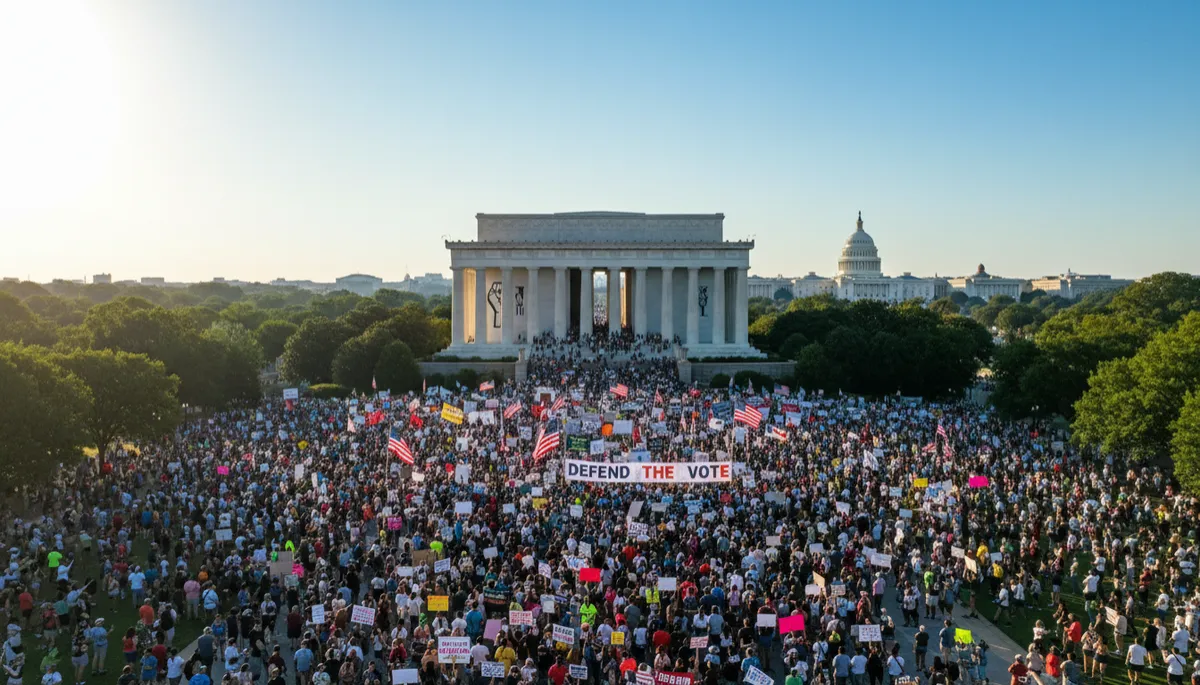
Thousands March on Washington to 'Defend the Vote' on the 63rd Anniversary of MLK's Historic March
WASHINGTON, D.C. — August 28, 2026 — On the very date that Dr. Martin Luther King Jr. delivered his immortal "I Have a Dream" speech 63 years ago, thousands of Americans returned to the National Mall to declare that the dream is still worth fighting for — and that the right to vote is under assault.
The 2026 "Defend the Vote" March on Washington, organized by the Rev. Al Sharpton and Martin Luther King III, drew massive crowds to the Lincoln Memorial plaza, echoing the urgency and energy of the original 1963 march while confronting a new and dangerous political landscape for Black Americans.
A Moment Unlike Any Other
"This one is different," declared Marc Morial, President and CEO of the National Urban League. And by all accounts, he was right. Civil rights leaders in 2026 say the stakes for this year's march are higher than any commemorative march since the original — following the rollback of voting rights, the erosion of economic opportunity, and the mysterious deaths of young Black men in the South that have gone inadequately investigated.
The march came just two months before November's midterm elections, a fact that was not lost on organizers or attendees. Leaders are mobilizing Black voters and their allies in a direct appeal to the ballot box, calling on communities to respond to years of policy decisions that have disproportionately harmed Black Americans.
The Supreme Court's Shadow: Louisiana v. Callais
Looming over Friday's march was the U.S. Supreme Court's landmark April 2026 decision in Louisiana v. Callais, which reinterpreted key provisions of the Voting Rights Act of 1965. The ruling allowed Southern states to redraw their congressional maps in ways civil rights organizations say erode equal representation in Black communities.
In Louisiana, legislators rushed to redraw congressional districts after the high court's decision, clustering previously protected majority-Black districts around predominantly white communities. Rep. Troy Carter, one of the figures at the center of the redistricting, has chosen not to seek reelection to Congress and is instead pursuing a state Senate seat.
"We've been doing these marches for years, but this is probably the most important because this is the first year we are marching that the voting rights bill has been nullified," Sharpton told the crowd from the steps of the Lincoln Memorial — the same steps where MLK once stood.
From the Ballot Box to the Courts
Ahead of Friday's march, major civil rights organizations — including the NAACP, the Lawyers' Committee for Civil Rights Under Law, and Black Voters Matter — filed new claims in federal court as part of their ongoing lawsuit against executive orders restricting mail-in voting. The Supreme Court cleared a path earlier in the week for possible implementation of those restrictions, though it remains unclear how much will be in place before November.
"We will not stand idly by while the voices of the people are silenced," said NAACP President Derrick Johnson in a statement. "We must protect every eligible citizen's right to cast their ballot."
The King Legacy on the Front Lines
Martin Luther King III, the eldest son of Dr. King and Coretta Scott King, told reporters that the 2026 event united a "cross-section of civil rights, labor, youth, faith, and community leaders from across the country," including nearly 100 organizations such as FairVote, Everytown, the NAACP, and Democracy Forward.
Arndrea Waters King, Dr. King's daughter-in-law and a key organizer, underscored the long-term mission: "The March is an important moment to come together, but carrying this work forward also means staying engaged and continuing to serve in our communities long after."
Confirmed speakers included New York Rep. Alexandria Ocasio-Cortez and Vermont Sen. Bernie Sanders — evidence of the ideologically diverse coalition that organizers have assembled around the singular issue of voting access.
The Youth Voice: 'It Happens at the Ballot Box'
Tylik McMillan, Director of Youth and College at the NAACP, spoke directly to young Black Americans in the crowd and watching online: "If we're going to change the things that we care about from education to healthcare to the environment to the economy, it happens at the ballot box."
That message resonated deeply at a march that organizers intentionally scheduled for August 28 — not only to mark the anniversary of MLK's 1963 speech, but also to honor the memory of 14-year-old Emmett Till, who was lynched on this date in 1955. It was an intentional decision by the 1963 march organizers to choose that date, and today's leaders are carrying that solemn tradition forward.
What's at Stake in November
With redistricting efforts in Republican-led states poised to reduce the number of Black lawmakers in Congress, November's midterms represent what many civil rights leaders call a critical inflection point. With thin Republican majorities in the House and Senate, the balance of power — and with it the future of federal civil rights enforcement — hangs in the balance.
For Black Atlanteans, the stakes are close to home. Georgia's own redistricting battles, voting access litigation, and the presence of Black voters as a decisive constituency in statewide races all make this a moment that demands full community engagement.
The 2026 March on Washington sends a clear message: Black America is not standing down. The votes will be cast, the voices will be heard, and history will remember who showed up.




