National Urban League's 2026 State of Black America: The American Dream Is Slipping Away
Civil Rights, Policy, Economic Justice
National Urban League's 2026 State of Black America: The American Dream Is Slipping Away
For 50 years, the National Urban League's State of Black America report has served as the most authoritative annual measure of Black progress and peril in the United States. The 2026 edition — the 50th — arrives at a moment of profound urgency. Its message is sobering: the American Dream, never fully within reach for most Black families, is now slipping further away. Faster than at any point in a generation.
Fifty Years of Tracking — and a Frightening Turn
NUL President and CEO Marc H. Morial presented the 50th edition at the organization's annual conference, and he did not mince words. "If you look at the short run, the past 16 to 18 months, we've witnessed the deterioration of the progress we've made over the past 60 or 70 years," Morial said. "And while we have made progress, the differences between Blacks and whites in all essential categories remain the same. That's the phenomenon and the paradox that has defined American society for centuries."
The report's key finding is stark: current policies — including restrictions on voting, attacks on diversity programs, reductions in federal civil rights enforcement, and economic policies that pressure working families — are actively threatening the gains that generations of Black Americans fought and died to secure. As the NUL put it plainly: this is not the time to be silent.
The Economic Crisis Hitting Black Families
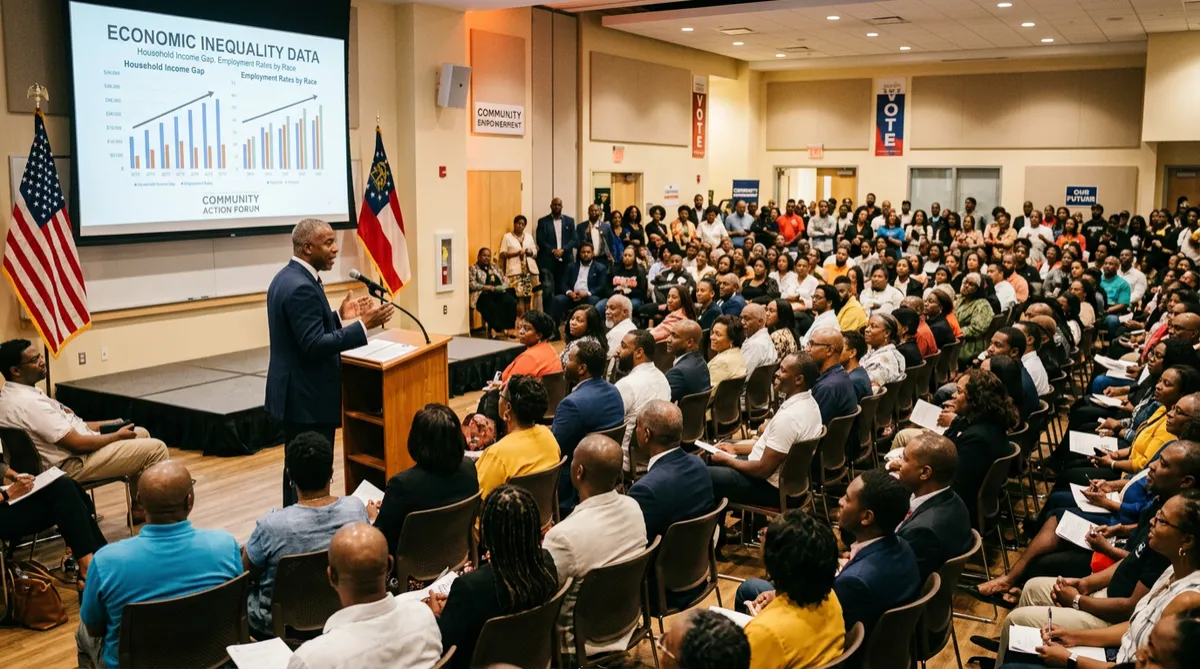
The 2026 report draws a clear picture of economic regression. The Black unemployment rate climbed to 7.5% this year — the highest since October 2021 and more than double the white unemployment rate. More than 300,000 Black women left the workforce in just the first half of 2025, driven out by a combination of job cuts, DEI rollbacks, and the elimination of federal programs that supported their advancement.
Morial's most gut-wrenching statistic: "A Black family is three times more likely to live in poverty than a White family." Despite decades of civil rights legislation, economic mobility programs, and community organizing, that ratio has barely moved. And now, with Medicaid cuts, federal workforce reductions, and AI automation eliminating jobs in manufacturing and service industries — sectors where Black workers are overrepresented — the gap threatens to widen further.
Voting Rights: The Battle Lines of 2026
The 2026 midterm elections carry stakes unlike any in recent memory. If Democrats reclaim the House majority, Congressional Black Caucus leader Hakeem Jeffries would become the first Black Speaker of the House in American history — a historic milestone that now hinges on whether Black voters can successfully exercise their rights at the ballot box this November.
But the report warns that the path to the ballot box is increasingly obstructed. The Supreme Court's rollback of Section 2 of the Voting Rights Act has opened the door to aggressive redistricting. Over a dozen states have rushed to redraw electoral maps ahead of November 2026. The proposed SAVE Act, if passed, could disenfranchise millions. NUL's analysis found that nearly 200 legislative seats currently held by African Americans could be eliminated if these measures succeed. "Voting should be the first chess move, not the last," said panelist Bruce Gordon.
DEI Rollbacks and the Workplace
Federal reductions in force, the elimination of DEI programs, and the rapid expansion of AI automation are reshaping the labor market — and hitting Black workers the hardest. Over 200,000 civil service employees separated from the federal government in the past year. In 2023, Black Americans made up 18% of the federal workforce; that share is now shrinking as anti-DEI policies eliminate positions and halt recruitment that built a more diverse civil service. Similar rollbacks are happening in the private sector and higher education.
Atlanta's Voice in the National Conversation
The Urban League of Greater Atlanta plays a crucial role in translating this national data into local action. President and CEO Nancy Flake Johnson said at the report's release: "The findings reinforce what we see every day in Atlanta and across Georgia: When communities have access to opportunity, they thrive. The path forward requires continued investment in education, workforce development, entrepreneurship, and policies that expand economic mobility."
Atlanta's unique position as a hub of Black economic power, HBCU excellence, and political leadership gives it a special responsibility in this moment. The decisions made here — in the voting booth, in the boardroom, in the classroom, and on the streets — will shape what the 51st State of Black America report says about this era.
What You Can Do — Right Now
Dr. Michael Eric Dyson, speaking at the NUL's opening plenary, put it plainly: "We need to recognize the value of coming together, working together. Collectively, we still possess what America's leaders currently in power desire. If we weren't great people, they wouldn't keep trying to stop us or kill us."
Van Jones urged the crowd to think politically and strategically: "Over the past 50 years, we've gone from being the underdog, to achieving our rights as full citizens, to becoming the underdog again." That cycle can be broken — but only if Black America organizes, votes, and refuses to be silenced.
Here's how Black Atlanteans can respond to this moment: Register and vote in every election — local, state, and federal — before November 3, 2026. Know your rights. Connect with the Urban League of Greater Atlanta and local civic organizations for voter education and workforce support. Support Black-owned businesses and institutions that build community wealth. Stay informed and share this report with your family, your barbershop, your church, and your social media. The 51st State of Black America report will reflect what we do in this moment. Let's make it a story of resilience, resistance, and revival.




