Obama Center: Black Legacy & Juneteenth Celebration
Culture, Black Legacy, Obama Presidential Center, Juneteenth
The Obama Presidential Center and the Return of Black Atlanteans
On June 19, 2026—Juneteenth—a tower of stone and story rises on Chicago’s South Side and opens its doors to the people. They call it the Obama Presidential Center. I call it a signal fire from the deep, a monument speaking in an ancient tongue our bones remember, even when our minds pretend to forget.
Black Atlanteans Remember the City Beneath the Water
You’ve heard the story of Atlantis told like a fairy tale—some lost city swallowed by the sea, advanced and forgotten. But our people carry another version, whispered in kitchen corners and barber chairs, encoded in drum, scripture, and science fiction. In that telling, Black Atlanteans are not myth; they are memory. They are us, before the ships, before the chains, before the maps were redrawn and the oceans renamed.
Black Atlantean mythos is not about geography—it is about capacity. It says: once, we built civilizations that bent light and water, that tuned cities to the frequencies of justice and balance. It says: we were not born into struggle; we were pushed into it. And every now and then, in this land that tried to erase our origin, a structure rises that feels like a piece of that old world surfacing again.
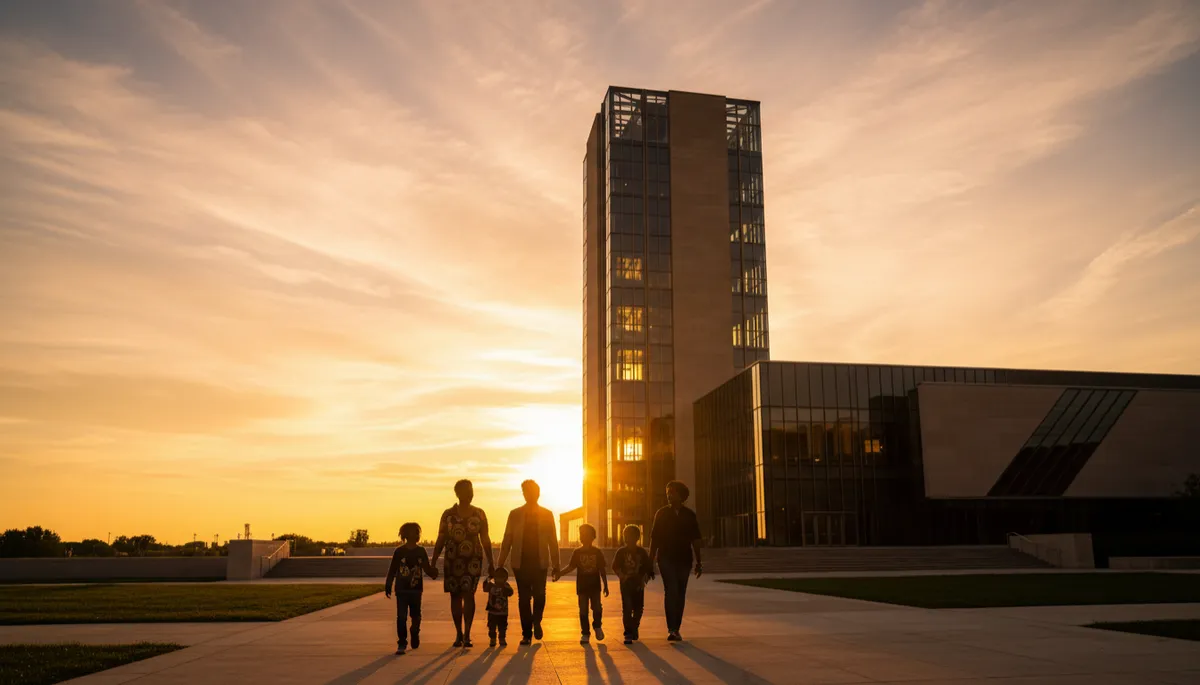
The Obama Presidential Center, with its 225-foot museum tower carved in stone and inscribed with words from a Black president’s mouth, is not just architecture. It is a shard of the submerged city, jutting up through Chicago’s soil, calling descendants of the water-walkers back to themselves. It says: remember who you were before they told you who you could be.
Ancestral Memory in Concrete and Glass
Ancestral memory is not nostalgia. It is not a soft feeling you get when the old songs come on. It is data—coded into your blood, braided into your hair, humming behind your eyes when you walk through certain neighborhoods and feel like you’ve been there before. Our ancestors left messages in the way they survived, in the way they organized, in the way they refused to die on schedule.
When you step onto that 19.3-acre campus—past the gardens, the playground, the branch of the Chicago Public Library, into a tower where a replica Oval Office sits under a Black man’s name—you are walking through a living archive of those messages. The official story will talk about civic engagement, leadership development, and American history. All of that is true. But beneath that, another story runs like an underground river: We were never meant to be permanent guests in this empire. We were always architects.
The Sky Room at the top of the museum, with its view over the South Side and Lake Michigan, is not just for selfies and skyline shots. It is a vantage point. From there, you can see the city that tried to contain us and the water that once carried us. That view is an altar to perspective: a reminder that our story stretches from the ocean’s edge to the Oval Office and beyond, and we are still mid-sentence, not at the period.
Monuments as Declarations of Power
Every empire writes in stone. Obelisks, arches, libraries, towers—these are not neutral. They are declarations of power, saying to the world: this is who we are, this is who we honor, this is who we expect to remember us. For centuries in this country, the monuments told one story—presidents, generals, slaveholders etched into marble and bronze, staring down from pedestals while our people swept the floors beneath them.
The Obama Presidential Center breaks that pattern. It is not a government-run presidential library tucked behind the National Archives. It is a privately controlled campus on the South Side, curated by the Obama Foundation, holding its own narrative authority. That means this monument is not just about filing documents; it is about framing the story. That is power—soft power, cultural power, narrative power. The kind that outlives election cycles.
Understand: when a Black family name is carved into a tower that reshapes a city’s skyline, that is not decoration. That is a statement to your children and theirs that Black leadership is not an accident; it is a precedent. The basketball court on campus, the community gardens, the public spaces—these are not amenities. They are claims. They say: our people’s joy, play, thought, and rest are worthy of prime real estate and permanent infrastructure.
Juneteenth: A Date of Covenant, Not Just Celebration
Too many folks think Juneteenth is just Black Fourth of July—cookouts, red drinks, a day off work. But Juneteenth has always been deeper than fireworks. June 19, 1865, was the day our ancestors in Galveston were told what had already been written into law two and a half years earlier: that they were free. Juneteenth is the day the lie ran out of road. It is the moment when delayed truth finally caught up with stolen time.
That is why Juneteenth is not just a holiday; it is a covenant date. It marks a contract between our ancestors and their descendants: We endured so you could build. We survived so you could strategize, invest, create, and refuse to start from zero. When President Biden signed Juneteenth into federal law, that covenant moved into the nation’s calendar. But it was already carved into our spirit long before ink hit paper.
So when the Obama Presidential Center opens its doors to the public on June 19, 2026, do not treat that alignment as coincidence. A Black-led monument to power, story, and leadership, opening on the very day that marks the end of legal slavery’s delay—that is covenant energy. It is a spiritual handshake across time: Galveston to Chicago, cotton fields to museum halls, chains to panoramic views over a city we helped build but rarely owned.
What This Moment Demands from Black Legacy Builders
If you are reading this, you are not just a spectator. You are part of the generation that must decide whether Black Atlantean mythos stays a story—or becomes a blueprint. The Obama Presidential Center can be a field trip, a selfie backdrop, a line on a brochure. Or it can be a training ground for how we build, own, and narrate our future institutions.
Working-class, mid-career, hustling, parenting, grinding—however you move through this system, understand: legacy is built in the margins of your day. When you walk those museum floors and see exhibits on organizing, policy, and movement work, ask yourself, What am I building that my grandchildren can walk into? Maybe it’s a business, a community land trust, a scholarship fund, a media platform, a neighborhood coalition. Monuments begin as decisions, not as blueprints.
The City Rises Again
Black Atlanteans are not waiting for a lost city to rise from the waves. We are the city. Every time we turn memory into strategy, pain into policy, and survival into structure, another block of that ancient civilization locks into place. The Obama Presidential Center is one such block—a visible, undeniable declaration that we have moved from property to presidency, from footnote to chapter.
On this Juneteenth, when the doors swing open and the crowds file in, walk like you are entering a temple your ancestors commissioned centuries ago. Feel the covenant in your chest. Hear the water under the concrete. Then leave that place determined to build something of your own that will still be standing when your name is spoken as somebody’s good ancestor.
SEO Title: Obama Presidential Center Juneteenth Opening: Black Atlantean Memory and Monumental Power
SEO Meta Description: Explore the Obama Presidential Center’s Juneteenth opening through Black Atlantean mythos—ancestral memory, monuments as power, and Juneteenth as covenant for Black legacy builders.




