
Rep. Crockett Demands DOJ Investigate Pattern of Possible Modern-Day Lynchings
Politics, Racial Justice, Civil Rights
“We Will Not Be Silent”: Rep. Jasmine Crockett Demands DOJ Probe of Possible Modern-Day Lynchings
On September 2, 2026, Congresswoman Jasmine Crockett put the Department of Justice on notice: Black people are still being found hanging from trees in America, and our communities refuse to accept rushed suicide rulings and silent institutions. In a forceful letter to Attorney General Todd W. Blanche and Assistant Attorney General Harmeet K. Dhillon, Crockett demanded a nationwide investigation into what she calls a “disturbing and unacceptable pattern” that echoes the terror of Jim Crow–era lynchings.
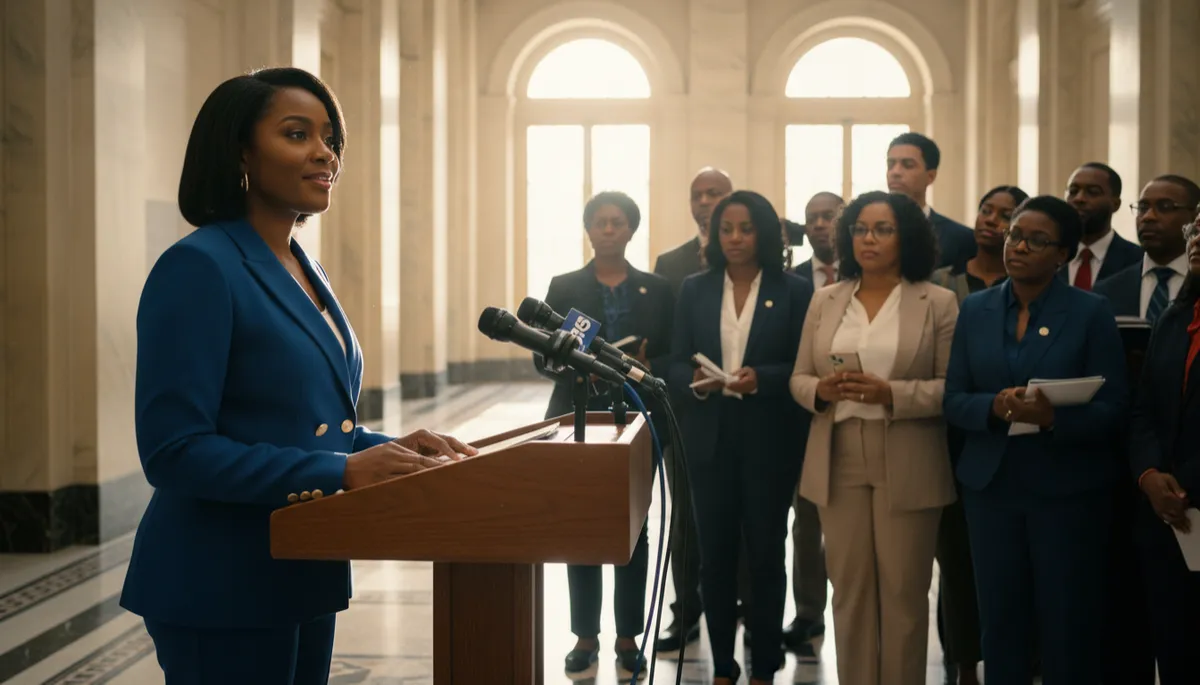
A Letter That Refuses to Look Away
As Ranking Member of the House Judiciary Subcommittee on Oversight, Rep. Jasmine Crockett (D‑TX) used the full weight of her position in her September 2 letter, calling on the DOJ’s top leadership to confront a chilling trend: Black Americans being found hanging from trees or similar structures, often in public or semi-public spaces, with local law enforcement quickly labeling these deaths as suicides—sometimes within hours, and often without transparent, independent review (crockett.house.gov).
Crockett’s letter, addressed directly to Attorney General Todd W. Blanche and Civil Rights Division head Harmeet K. Dhillon, frames the issue not as a series of isolated tragedies but as a possible national pattern—one that demands a coordinated federal response, not just quiet local case closures. She warns that, without intervention, the United States risks repeating one of the darkest chapters in its history, when lynching was used as a tool of racial terror while government entities looked away or actively colluded.
“Black Americans Are Being Found Hanging in 2026”
On the same day the letter was sent, Crockett took to social media to make her message plain and public. “Black Americans are being found hanging in 2026,” she wrote. “For generations, Black people were lynched while institutions stood by and did nothing. We cannot repeat that history. I’m demanding a full investigation from the DOJ.” (substack.com).
That framing matters. Crockett is not simply asking for case-by-case reviews. She is insisting that the federal government recognize these deaths as part of a wider pattern of racialized violence and institutional neglect. In her letter, she stresses that every unexplained hanging of a Black person in this country must be treated with the gravity of our historical reality—especially when law enforcement itself may be implicated or disincentivized from digging too deeply.
Twenty-Three Cases, One Grim Pattern
Central to Crockett’s demand is a chilling data point: her letter cites 23 documented cases in recent years in which Black Americans were found hanging and where police officers, sheriff’s deputies, or correctional officers were directly involved—either as the investigating agency, as potential witnesses, or, in some instances, as alleged perpetrators or accomplices. In several of these cases, families and community advocates have raised serious questions about:
- The speed with which deaths were declared suicides, sometimes before autopsies were complete.
- Apparent conflicts of interest when departments investigated their own officers or colleagues.
- Missing or incomplete forensic evidence, including lack of DNA testing, failure to preserve the scene, or uncollected video footage.
- Patterns of prior threats, racial harassment, or use of slurs directed at the victims that were never fully explored.
While Crockett’s letter does not publicly name every victim—out of respect for families and ongoing legal concerns—it makes clear that these 23 cases are not random. Many occurred in jurisdictions already under scrutiny for racial profiling, excessive force, or civil rights violations. Others took place in or near jails and prisons, where correctional officers hold extraordinary power and where “suicide” is too often a label that closes the file rather than opens an honest investigation.
Systemic Investigative Failures and Racial Animus
Crockett situates these 23 cases within a broader landscape of systemic investigative failure in matters involving racial animus. From frozen civil rights probes in schools to racial profiling in immigration enforcement and policing, recent reporting has exposed deep cracks in how institutions handle racist violence and harassment.
The Washington Post, for example, has documented how the U.S. Department of Education’s Office for Civil Rights under the current administration has stalled dozens of investigations into racial and sexual harassment, including a case involving a Black fifth-grade girl who was called a “monkey” and compared to a slave by classmates. Once Trump’s second term began, the number of completed racial harassment resolutions plummeted, leaving students and families without justice (washingtonpost.com).
In immigration enforcement, an ACLU report titled Agents of Chaos and Cruelty catalogues more than 400 incidents of misconduct in a single year—racial slurs, excessive force, and intimidation—by agents operating with little accountability (aclu.org). In Los Angeles, a “frat-like” culture inside the LAPD’s hiring unit was exposed through recordings of racist, sexist, and homophobic remarks, yet meaningful accountability has lagged, even as thousands of bias complaints over nearly a decade resulted in only three sustained findings (latimes.com).
These examples are not directly about hangings, but they reveal a consistent pattern: when Black lives are at stake and racism is in question, institutions too often slow-walk, sidestep, or sanitize the truth. Crockett’s letter argues that this same culture of denial and deflection cannot be allowed to shape the narrative around Black people found hanging—especially when the imagery and history of lynching are so deeply rooted in racial terror.
Echoes of the Noose: Historical Context of Lynching in America
Between the end of Reconstruction and the mid‑20th century, thousands of Black men, women, and children were lynched in the United States. The Equal Justice Initiative has documented over 4,000 racial terror lynchings in the South alone from 1877 to 1950, often carried out in public, with law enforcement either participating or standing by. These lynchings were not only acts of murder; they were messages—warnings to Black communities that white supremacy would be enforced with brutality and impunity (eji.org).
The Southern Poverty Law Center notes that lynching was a tool of social control, used to punish perceived “transgressions” like voting, owning land, asserting dignity, or simply being in the wrong place at the wrong time while Black (splcenter.org). These killings were often followed by sham investigations, if any investigation occurred at all. Coroners wrote “accidental death” or “suicide” on certificates. Juries refused to indict. Newspapers minimized or justified the violence. The state, in effect, signed off on terror.
Crockett’s letter insists that we see today’s unexplained hangings of Black people against this backdrop. When a Black person is found hanging from a tree in 2026, the question is not only what happened in that moment but also what history walks into that case with us. For Black communities, a hanging is never just a hanging. It carries the memory of postcards of lynched bodies, of crowds smiling beneath trees, of sheriffs who “couldn’t find” the killers everyone in town knew by name.
What Crockett Is Demanding from the DOJ
In her September 2 letter, Crockett does more than sound the alarm; she lays out a blueprint for federal action. Among the steps she urges the DOJ to take are:
- A nationwide review of recent cases in which Black people were found hanging, with special attention to those quickly ruled suicides.
- Full involvement of the Civil Rights Division in assessing whether racial animus, hate crimes, or civil rights violations were ignored or minimized in local investigations.
- Independent oversight and, where necessary, the appointment of outside investigators or federal monitors in jurisdictions with repeated failures or conflicts of interest.
- Transparent public reporting on the status and findings of these reviews, so that families and communities are not left in the dark.
Crockett also calls for updated DOJ guidance to local law enforcement on how to handle cases that carry the historical weight and contemporary trauma of lynching. That includes mandatory consideration of hate-crime statutes, robust forensic protocols, and clear requirements for when outside agencies must be brought in to avoid conflicts of interest—especially when police or correctional officers may themselves be implicated.
“We Refuse to Let Our People Be Written Off”
In public remarks amplifying the letter, Crockett has been clear that this fight is about dignity as much as it is about data. “For generations, this country tried to tell our people that what we saw with our own eyes was not real,” she said in one recent interview. “They called lynchings ‘justice.’ They called terror ‘keeping order.’ Today, when a Black person is found hanging and the system rushes to say ‘suicide’ without doing the work, that is a continuation of the same disrespect. We refuse to let our people be written off.”
Crockett’s language is unapologetically direct. In another statement shared by her office, she noted, “Black Americans are not asking for special treatment; we are demanding equal protection. When our communities see bodies hanging and questions ignored, it tells us our lives are still negotiable in the eyes of the state. That is unacceptable, and as long as I hold this seat, I will use it to challenge that lie.”
Modern-Day Lynching: Beyond the Rope and the Tree
Civil rights organizations like the NAACP and Equal Justice Initiative have long argued that “modern-day lynching” is not just about the method of killing but about the structure of impunity around Black death (naacp.org). Police shootings without accountability, vigilante violence excused as “self-defense,” and hate crimes shrugged off as isolated incidents all fit within this larger pattern when the system fails to protect Black life and truthfully tell what happened when that life was taken.
The International Commission of Inquiry on Systemic Racist Police Violence has documented how law enforcement agencies sometimes construct false narratives after deadly encounters—misstating victims’ actions, clothing, or threats in ways later contradicted by video or eyewitness accounts (inquirycommission.org). Crockett’s letter implicitly connects this culture of narrative manipulation to the current spate of hangings: if institutions are willing to bend the truth in shootings caught on camera, what might they be willing to overlook—or mislabel—when a Black person is found hanging alone, with no immediate witnesses?
For Black Americans and Black Atlanteans, This Is Personal
Across the African diaspora—from Black communities in the United States to Black Atlanteans who have built new lives in the South and beyond—the sight or even the mention of a Black person hanging from a tree lands like a blow to the chest. It is not abstract. It is ancestral memory. It is the whispered stories our elders told, the names never printed in history books, the photographs we wish we could unsee but must never forget.
Crockett’s intervention speaks directly to that memory and to our present-day insistence on survival. It says: we see what is happening, we know the history, and we will not be gaslit into silence. For many Black readers, her letter is not just a policy document; it is a statement of solidarity from inside the halls of power, a reminder that there are voices in Congress who understand that our grief and our suspicion are grounded in lived reality, not paranoia.
What Accountability Could Look Like
If the DOJ takes Crockett’s letter seriously, the path forward could reshape how this country responds to suspicious deaths of Black people for generations to come. Real accountability would mean:
- Reopening questionable cases where evidence was ignored, families were sidelined, or conflicts of interest tainted investigations—especially among the 23 cases Crockett highlights involving law enforcement or correctional officers.
- Federal civil rights prosecutions where there is evidence that racial animus, hate-crime motives, or official cover-ups played a role in a death or its aftermath.
- National standards for death investigations involving potential lynching, including mandatory autopsies, independent medical examiners, and automatic civil rights review when the victim is Black and the method is hanging.
- Community transparency, with regular updates shared publicly, not just quiet memos passed between agencies, so that families are not forced to become private investigators to learn what happened to their loved ones.
Crucially, accountability would also mean listening to Black communities themselves—to families, faith leaders, organizers, and local journalists who have been raising alarms long before this letter reached DOJ leadership. Rep. Crockett’s demand opens the door; sustained community pressure will determine how far that door swings.
Turning Grief into Power
For Black Americans and Black Atlanteans, the work ahead is both heavy and hopeful. Heavy, because confronting the possibility of modern-day lynching means reopening wounds that never fully healed. Hopeful, because leaders like Jasmine Crockett are refusing to let those wounds be ignored or exploited in silence. Her letter is a reminder that our communities are not helpless spectators—we are historians, witnesses, organizers, and policymakers in our own right.
“We come from people who survived the rope, the river, the chain, and the cage,” Crockett has said. “Our ancestors did not endure all of that for us to accept mystery and silence when our people are found hanging in this country. We owe them the truth. We owe ourselves the truth.” That insistence on truth is not only an indictment of institutional failure; it is an affirmation of Black life, Black memory, and Black future.
Where We Go from Here
As we await the DOJ’s response to Crockett’s September 2 letter, one thing is clear: the days when Black deaths could be quietly filed away without scrutiny are over, so long as our communities stay informed and organized. The 23 cases she cites are not just numbers; they are families, futures, and stories that deserve more than a line on a police report. They deserve a country willing to confront its past and transform its present.
Whether you are in Atlanta, Houston, the Bronx, or a small town where your family has lived for generations, this moment calls for vigilance and voice. Ask questions when you see suspicious deaths dismissed. Support local Black journalists and organizers who track these stories. Demand that your representatives stand with leaders like Jasmine Crockett in calling for federal accountability. Our ancestors survived a world where lynching was lawless and unspoken. We are building a world where no Black death goes unquestioned, and no Black life is disposable.
Rep. Jasmine Crockett’s demand to the DOJ is not the end of this struggle. It is a powerful step in a long walk toward justice—a walk our people have been on for centuries, and one we will continue with clear eyes, steady voices, and an unshakable commitment to the truth.




