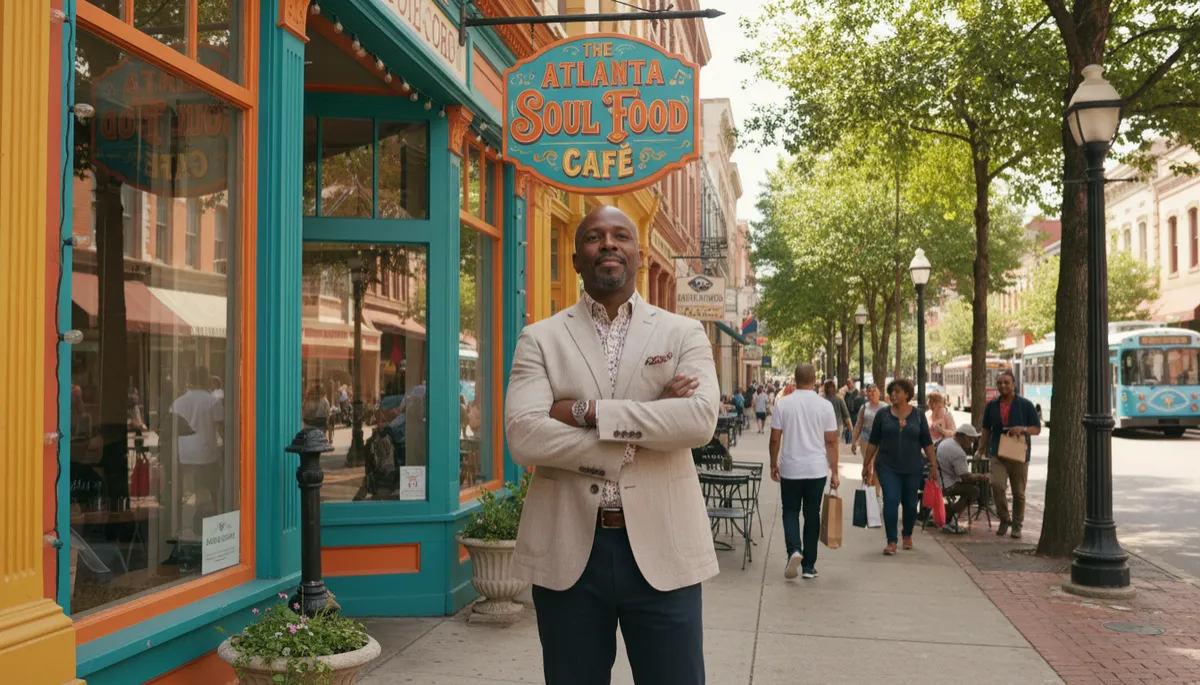
Rising Rents Are Erasing Atlanta's Black Business Corridors — But There's a Plan
Rising Rents Are Erasing Atlanta's Black Business Corridors — But There's a Plan
On a Friday, the owner of BUZZ Coffee and Winehouse in Cascade Heights found out his rent was going up 22%. By Monday, the business was gone.
BUZZ had survived five years of building community in Southwest Atlanta. It had weathered a pandemic. It had built a loyal customer base, a warm and welcoming atmosphere, and a reputation as exactly the kind of neighborhood anchor that every community deserves. The business was not failing. By any measure, it was thriving. But a 22% rent increase made it impossible to stay. And just like that, a piece of Black Atlanta was erased.
That story is not an outlier. According to researchers at Kindred Futures, an Atlanta-based policy and research organization, what happened to BUZZ is the story of Atlanta's historically Black commercial corridors right now. And if nothing changes, it will get worse.
What Commercial Gentrification Looks Like in Atlanta
When most people think of gentrification, they think of residential displacement — longtime Black homeowners and renters being priced out of their neighborhoods as property values rise. And that is a real and devastating crisis in Atlanta. But commercial gentrification — the displacement of Black-owned businesses from neighborhoods they built and sustained — receives far less attention and is equally destructive.
Atlanta's historically Black commercial corridors — Auburn Avenue, Cascade Heights, West End, Bankhead, Pittsburgh, and others — have been economic, cultural, and social anchors for the Black community for generations. They are where Black entrepreneurs built wealth. Where Black professionals found office space. Where families found services, food, entertainment, and community. They are where Black identity took commercial form.
As Atlanta's real estate market has heated up — driven by an influx of new residents, corporate relocations, and speculative investment — commercial rents in these corridors have skyrocketed. Leases are not being renewed. Rent increases are arriving that no small business operating on thin margins can absorb. The businesses that defined these corridors are being pushed out, often replaced by chains or higher-end establishments that serve an entirely different demographic.
When Black businesses disappear from Black corridors, the loss is not just economic. It is cultural. It is communal. It is the loss of a social infrastructure that cannot simply be replaced by a new tenant.
The Staying Power Toolkit: A Community Response
Into this crisis steps Kindred Futures — and their newly released Staying Power Toolkit. This is not a report that simply documents the problem and moves on. It is a practical, actionable playbook for policymakers, community organizations, and business owners who want to keep Black businesses in Black neighborhoods.
The toolkit organizes its strategies into three categories:
Capital Strategies: This includes dedicated rent stabilization funds that provide relief to Black business owners facing sudden, unaffordable rent increases — giving them breathing room to renegotiate, relocate, or restructure. It also includes community acquisition vehicles — mechanisms that allow community organizations, CDFIs, and Black investors to purchase commercial properties, removing them from the speculative market and ensuring they remain accessible to Black businesses long-term.
This is critical. As long as commercial real estate in Black neighborhoods is owned by outside investors with no community ties, Black businesses will always be vulnerable to rent spikes driven by market speculation rather than community need. Community ownership changes the equation.
Spatial Strategies: The toolkit proposes unlocking underused industrial and commercial land for small-scale retail and community-serving businesses. Atlanta has significant tracts of underutilized land in and around historically Black neighborhoods. Repurposing this land for community-scale commercial development — with priority access for Black entrepreneurs — could create new opportunities without displacing existing businesses.
Ecosystem Strategies: Perhaps the most underappreciated piece of the toolkit is its focus on the networks and relationships that help business owners survive and grow. Black entrepreneurs often build businesses in relative isolation — without access to the referral networks, business associations, and peer communities that give other entrepreneurs critical support. The toolkit calls for intentional investment in these ecosystems: mentorship networks, peer business associations, shared back-office services, and collective purchasing power.
What This Means for Black Atlanta
The Staying Power Toolkit is important not just as a policy document but as a statement of values. It insists that commercial space is a community asset — not simply a commodity to be bought and sold to whoever offers the highest price. It insists that the economic and cultural contributions of Black-owned businesses to their communities have value that the market does not automatically recognize or protect.
That is not a radical idea. It is a recognition of something Black Atlanta has always known: our businesses do not exist in isolation. They exist within communities that they help sustain. When they thrive, the whole neighborhood thrives. When they disappear, the whole neighborhood loses something.
What the toolkit asks of policymakers is not enormous. Rent stabilization funds require political will and funding, but they are not unprecedented — cities across the country have implemented commercial rent stabilization measures for small businesses. Community land acquisition requires patient capital and institutional infrastructure, but those institutions already exist in Atlanta in the form of CDFIs, community development organizations, and Black-led investment funds.
What You Can Do Right Now
Policy takes time. But community action can start today. Here is what each of us can do to help keep Black businesses in Black neighborhoods:
Spend with intention: Every dollar you spend at a Black-owned business in your neighborhood is a vote for that business's survival. Make it a habit — not just this month, but every month.
Know your local businesses: Walk your neighborhood's commercial corridors. Introduce yourself to the owners of Black-owned businesses you have never patronized. Ask what they need. Come back.
Advocate for policy change: Contact your city council member and district representative. Ask them where they stand on commercial rent stabilization for small businesses in historically Black corridors. Make it clear that this is a priority for you and your community.
Invest in community ownership: If you have resources to invest, explore community land trusts, CDFIs, and Black-led real estate investment vehicles that prioritize keeping commercial space affordable in Black neighborhoods. Your investment can be part of the solution.
Share the story: The more people know about commercial gentrification and its impact on Black communities, the more pressure builds for solutions. Share this article. Talk about BUZZ. Talk about what Black corridors mean to Black communities — and what it costs when they disappear.
Black Atlanta Built These Corridors. Black Atlanta Should Keep Them.
Sweet Auburn was built by Black Atlanta. West End was built by Black Atlanta. Cascade Heights was built by Black Atlanta. These corridors did not emerge by accident — they are the product of generations of Black entrepreneurship, Black investment, and Black community-building under conditions of systemic exclusion from mainstream economic life.
The forces of commercial gentrification are powerful. The market does not naturally protect what communities have built. But the Staying Power Toolkit makes clear that this does not have to be inevitable. With the right policy tools, the right community infrastructure, and the right collective will, Black Atlanta can keep its corridors — and the businesses, the culture, and the community wealth they represent.
The fight for our neighborhoods is also the fight for our economic future. And that is a fight worth having.
Black Atlanteans will continue to report on commercial gentrification, Black business preservation, and the fight for economic self-determination in Atlanta. Stay with us — and stay spending Black.




