
SpaceX Starship Launch: A Leap for Black Futures
Space, Innovation, Black Excellence
SpaceX’s Most Powerful Starship Takes Flight — And Why It’s a Moonshot for Black Futures
On May 23, 2026, the world looked up as SpaceX’s upgraded Starship thundered off the Texas coast on a high‑stakes test flight — a colossal rocket that NASA is counting on to carry humanity, and eventually Black astronauts, back to the moon.
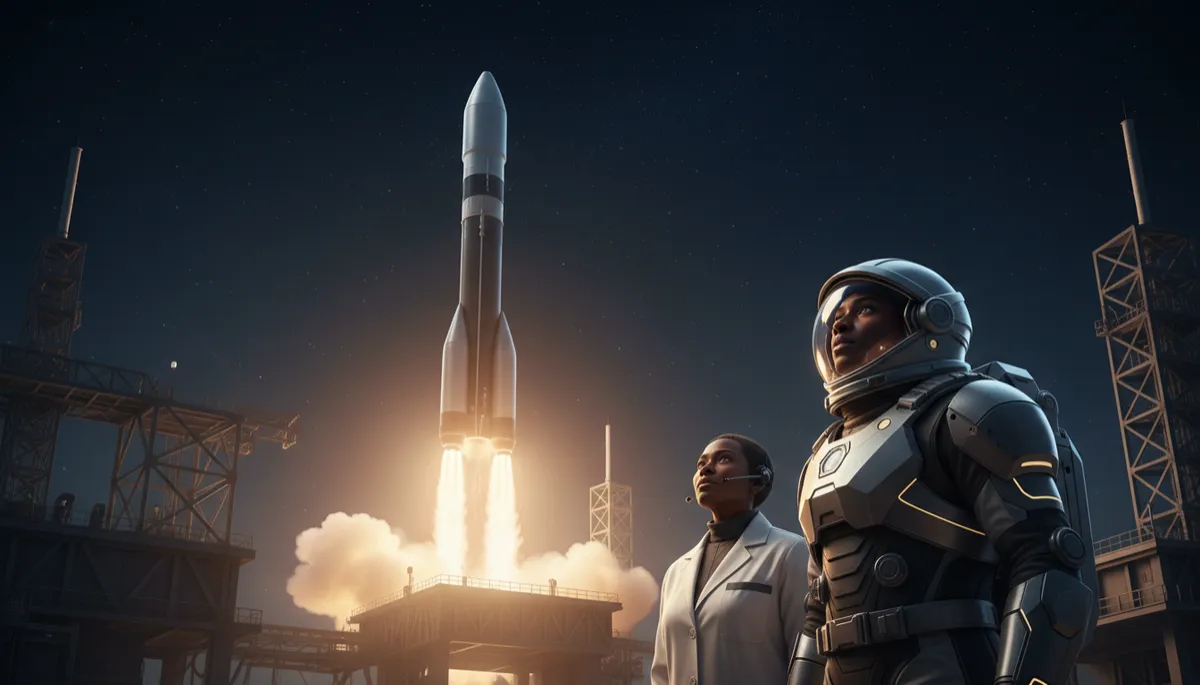
A Test Flight That Redraws the Horizon
This latest Starship test is more than another rocket launch. It is a full‑scale rehearsal for humanity’s return to the lunar surface — and the most powerful, fully reusable launch system ever to leave Earth. NASA has tapped Starship as the lunar lander for its Artemis program, the same initiative that already flew the crewed Artemis II lunar flyby in April 2026 (NASA). Each successful Starship test closes the gap between where we stand today and the moment new bootprints press into the moon’s dust.
For affluent, forward‑looking Black families watching from living rooms, rooftop decks, and private lounges, this isn’t just a spectacle in the sky. It is a live, blazing signal that the next era of space — and the wealth, opportunity, and influence that come with it — is being written right now.
What Makes This Starship the Most Powerful Ever Built
Standing at roughly 124 meters tall, this upgraded Starship towers over every rocket in history. Its Super Heavy booster packs 33 next‑generation Raptor engines, while the Starship upper stage adds six more, delivering a level of thrust that eclipses even the Saturn V that took Apollo astronauts to the moon (AP News).
This version is designed to be fully reusable — a game‑changer. Reusability is what can drive launch costs down from “only nations can afford this” to “visionary companies, universities, and even coalitions of communities can play.” On its recent test flights, Starship has flown suborbital trajectories halfway around the world, released mock satellite payloads, and pushed the envelope on engine performance and precision control, even when some engines failed mid‑flight (TechCrunch).
The significance is simple and profound: a rocket this powerful and this scalable is the backbone of an entirely new space economy — one where lunar bases, deep‑space research labs, and even private orbital habitats move from science fiction into strategic investment territory.
The New Moon Timeline: From Flyby to First Steps Back
The path back to the moon is no longer abstract; it is scheduled, funded, and underway. Artemis II, launched April 1–10, 2026, successfully carried four astronauts — including Black NASA astronaut Victor Glover — on a historic lunar flyby, validating Orion’s systems and NASA’s deep‑space communication networks (NASA Science).
Through late 2026, NASA’s Commercial Lunar Payload Services program will send a wave of robotic landers — including missions like Intuitive Machines’ IM‑3 — to scout landing sites, test technologies, and deliver instruments to the lunar surface (IM‑3). In 2027, Artemis III will act as an Apollo 9‑style orbital test, rehearsing critical maneuvers with a lunar lander and new spacesuits in Earth orbit before committing crews to land (NASA).
The first crewed landings under the revised architecture are expected with Artemis IV and beyond, from 2028 onward. Starship is the vehicle NASA is betting on to ferry astronauts from lunar orbit down to the surface and back. Every successful test like this one accelerates that timeline, making it more likely that the first Black woman and the next generation of diverse explorers will stand on the moon within this decade.
Why This Moment Matters Deeply for Black America
Space has always been about more than rockets; it is about who gets to define the future. High‑visibility projects like Starship are powerful catalysts for Black participation in STEM. They ignite curiosity in our children, justify new aerospace programs at HBCUs, and expand scholarship pipelines into fields like propulsion, robotics, AI, and planetary science (Forbes Tech Council).
As SpaceX and NASA scale up, they create high‑impact careers — from systems engineering and mission design to data science and advanced manufacturing. For Black professionals already established in tech, finance, and entrepreneurship, this is a call to lean in: to invest, to partner, to mentor, and to ensure that Black talent is present at every table where the next space economy is being architected (NASA & SpaceX).
There is also a deeper, almost spiritual resonance. Our ancestors were once forced to navigate by stars under conditions of unimaginable constraint. Today, their descendants are designing the vehicles that will carry humanity to those same celestial bodies. When a Black child watches this Starship rise and whispers, “That could be me,” that is not just inspiration — it is generational repair, and it is strategic power.
A Lunar Future, Claimed with Intention
The upgraded Starship’s test flight on May 23, 2026, is a milestone not just for SpaceX or NASA, but for anyone determined that the next chapter of human exploration will be more inclusive, more equitable, and more visionary than the last. The moon is becoming a proving ground for technologies that will shape energy, materials, communications, and even off‑world real estate for generations to come.
For conscious, future‑focused Black Americans, the message is clear: this is not a distant spectacle. It is a live invitation. To fund STEM programs and space‑focused nonprofits. To back founders building at the edge of aerospace and AI. To encourage your children, nieces, nephews, and godchildren to see themselves not just as consumers of space history, but as authors of it.
Starship’s fire on the launchpad is a preview of the world we are building — one where Black brilliance is not an exception in space, but an expectation. The countdown has already started. The only question now is how boldly we choose to answer it.




