States Fight Back After Voting Rights Setback
Politics, Voting Rights, Black Legacy, State Power
After the Supreme Court Gutted Voting Rights, States Are Fighting Back — Here's How
The high court has weakened the Voting Rights Act almost to a whisper, but the story is not over. In this season, Black men who think in decades, not news cycles, must understand what was taken, what we still control, and how to build power that no court can casually erase.
What Was Lost When the Court Swung the Axe
The Supreme Court’s ruling in Louisiana v. Callais did not just tweak the law; it cracked the spine of the federal Voting Rights Act. For decades, Section 2 protected Black voting rights by looking at results. If a map diluted Black power, you could challenge it without having to read the mind of the mapmaker. That standard made sense because racism rarely announces itself on official letterhead.
Now, the Court says you must prove intentional discrimination. Justice Kagan called it a “demolition” of the Act, and she was not exaggerating. The Court then rushed to let Alabama and Louisiana use maps that lower courts had already called discriminatory. In Alabama, that means going into the 2026 elections with only one majority-Black district where there should be two. That is not theory; that is a seat, a voice, a vote in Congress, gone.
Understand what this signals. The federal referee has stepped off the field. The same institution that once enforced desegregation is now clearing the lane for racial gerrymandering and aggressive state voting laws that slice away at our power. Section 5 preclearance was gutted years ago. Now Section 2 is “all but a dead letter.” The message from the Court is simple: “Do not look to us to save Black democracy.”
What’s Being Built in the States While the Feds Retreat
Yet even as the federal shield cracks, new armor is being forged closer to home. Several Democratic-led states are passing their own state voting rights acts and rewriting state voting laws to protect access. These laws often mirror or even go beyond the old federal Voting Rights Act, banning racial vote dilution, expanding early voting, and guarding against purges and intimidation at the polls. Where the Supreme Court has stepped back, state constitutions and state courts are stepping in as the next line of defense.
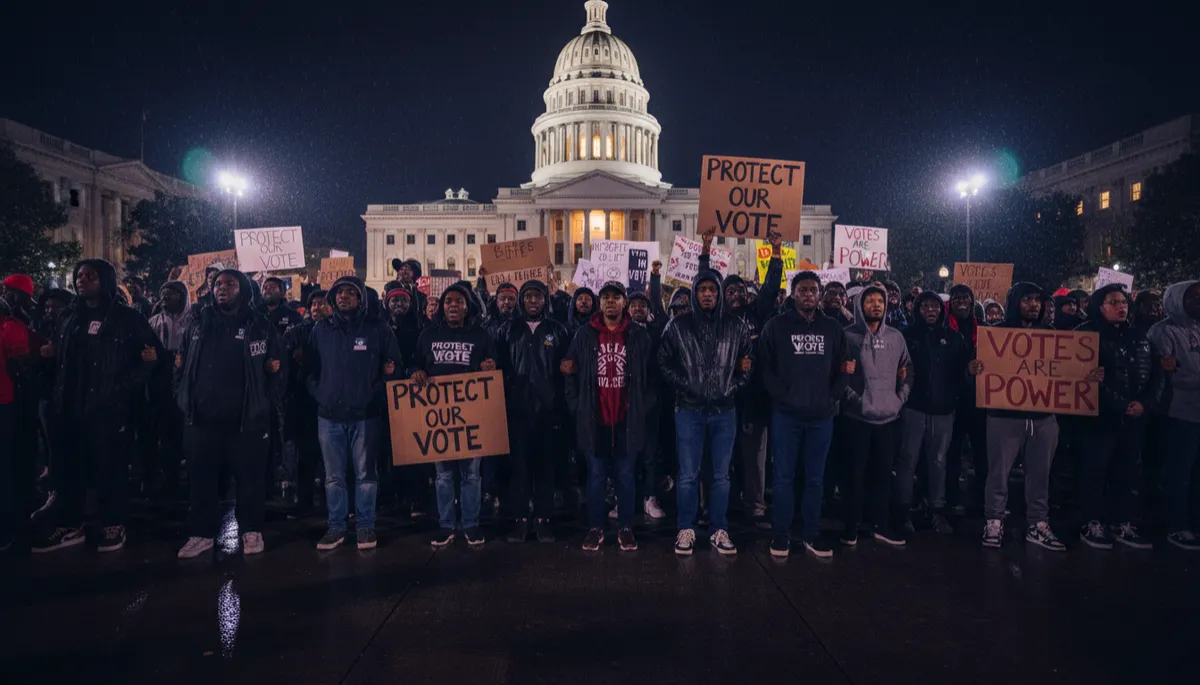
In some states, Black lawmakers and allies are using redistricting not just to resist harm, but to build opportunity — drawing maps that keep Black communities intact instead of splitting us into weak slivers. Independent commissions, stronger state-level protections, and aggressive litigation in state courts are becoming the new playbook. That is why rallies in Alabama, Selma, Montgomery, and beyond matter. They are not just about pain; they are pressure on governors, legislators, and judges who still answer to state constitutions and to us at the ballot box.
The Limits — and Real Power — of State-Level Protection
Let’s be clear and sober. State protections are not a magic shield. Many of the states where Black voters are most targeted — Alabama, Mississippi, Louisiana, Texas — are run by leaders who see our political power as something to manage, not respect. They are already using the Supreme Court’s new standard to lock in maps that weaken us for years to come. In those states, state legislatures are the problem, not the solution, and state courts can be just as hostile as the federal bench.
But there is another side to this. Where we have numbers and organization, we can take over school boards, county commissions, city councils, prosecutors’ offices, and even statehouses. In those places, state voting laws can become tools in our hands: automatic registration, fair maps, protections for returning citizens, language access, robust early voting. Think of state law as a sword and a shield. In enemy territory, it cuts us. In territory we control, it defends and extends our reach.
So the question is not only, “What will the state do?” The deeper question is, “Who will control the state?” Men who build legacies do not just complain about the rules; they position themselves to write them. That is the level of thinking this moment demands.
Beyond Court Cycles: How Black Communities Build Durable Power
Courts move in cycles; empires of power last when they are rooted in institutions we control. If you are a Black man between 35 and 65, you are in your stewardship years. This is not about vibes or headlines. This is about what your sons, daughters, nieces, nephews will inherit when you are gone. To build something that outlives Supreme Court moods, we must move on four fronts.
- Organize the block, not just the ballot. Voting is one move; organization is the board. Build or strengthen neighborhood councils, church-based civic teams, local Black business alliances, and ward-level political clubs. When a map changes, a well-organized neighborhood can still turn out, still negotiate, still demand. Loose individuals get gerrymandered. Tight formations adjust and survive.
- Invest in political education, not just election season hype. Men who move like elders study the terrain. Host regular sessions in barbershops, lodges, and living rooms breaking down how redistricting works, how state constitutions function, and how local offices touch your money, your children, your freedom. When people understand the game, turnout is not a favor to a candidate; it is a defense of the tribe.
- Develop our own candidates and infrastructure. Stop waiting for perfect saviors to appear every four years. Recruit, train, and fund Black candidates for school board, judge, sheriff, state house, and Congress. Build PACs, legal defense funds, and data operations controlled by us. The other side is playing a long game with think tanks, law firms, and donor networks. We cannot answer that with vibes and hashtags alone.
- Anchor political power in economic and cultural power. A community that owns land, businesses, and media has leverage when laws shift. Support Black-owned banks, credit unions, and investment circles that can fund campaigns and advocacy. Back local Black media that tells the truth about Black voting rights attacks instead of numbing us with distraction. Culture and capital are the deep current under every law.
Standing in This Moment Like Ancestors Are Watching
The Supreme Court has made its position clear. The old federal guardrails that once protected our right to vote are cracked. But our ancestors did not cross bridges, face dogs, and bury martyrs so that we would treat courts as gods. They fought knowing the law could be both weapon and wound, and they built anyway. Today’s rulings are serious, but they are not the final word on Black destiny.
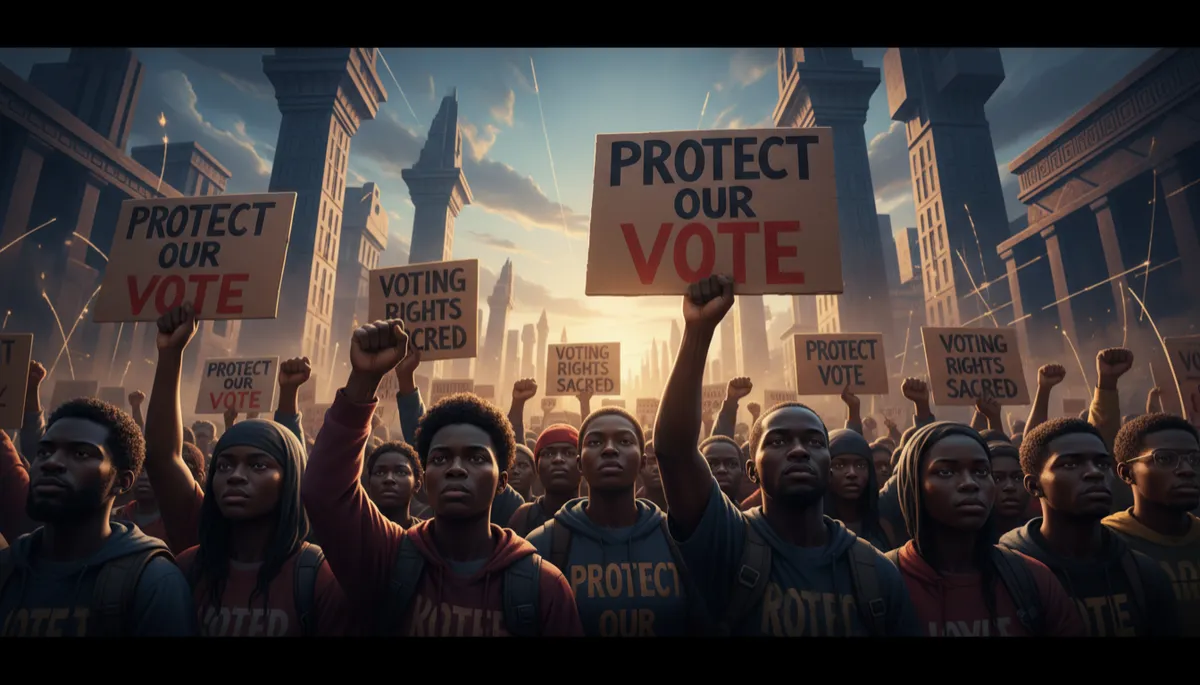
In Alabama, in Louisiana, across the South and beyond, people are already in the streets with Protect Our Vote signs, chanting under dramatic skies, refusing to go quietly. That is the surface. Beneath it, the real work is deciding that we will master state and local power, not just react to it. We will learn the maps, learn the laws, and place our people in the rooms where those lines are drawn.
Legacy builders do not flinch when an empire shows its teeth. We adjust, we strategize, we build structures that last. The Voting Rights Act may be wounded, but Black will is not. The question before you is simple: in this chapter of history, will your name be listed among the men who watched, or the men who moved? The court has played its hand. Now it is our turn.




