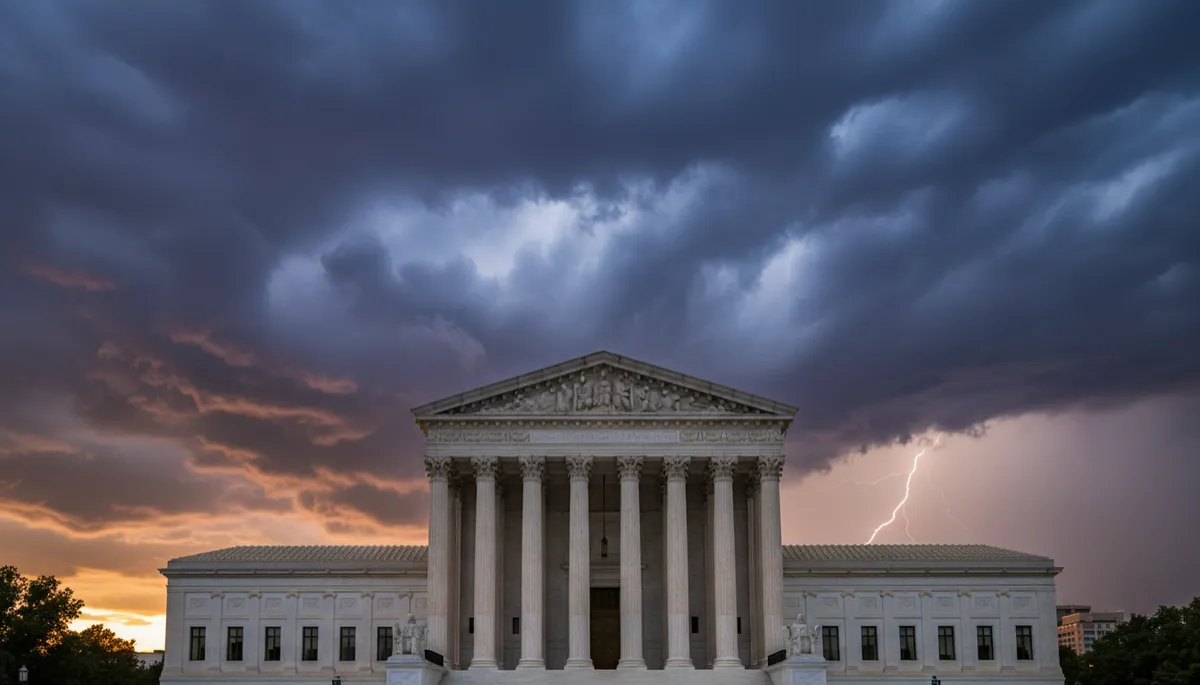
Supreme Court's New Maps: Impact on Black Voting
Politics, Supreme Court, Black Voting Rights
The Supreme Court Redraws the Map: What the New Congressional Districts Mean for Black America
Sit down for a minute, son. The mapmakers have been at work again, and this time the Supreme Court itself is holding the pen. Louisiana, Texas, Virginia, California — the lines have shifted, and with them, the balance of power over Black voting rights and our children’s future.
The Old Game with New Pieces
You’ve seen this movie before, even if they changed the costumes. In my father’s day it was poll taxes and literacy tests. In my youth it was at-large elections and “law and order.” Today they call it redistricting, congressional maps, and “race-neutral” lines. But beneath the fancy language, the game is the same: decide who counts, and who can be counted out.
The Supreme Court has stepped in again and again, reshaping maps in Louisiana, Texas, Virginia, and California. These aren’t just lines on paper. They are pipelines of federal money, protection, and power. Every district is a doorway — either open for Black communities or quietly shut in our faces.
Louisiana: The Second Black Voice Silenced
In Louisiana, the case they call Louisiana v. Callais was about one simple thing: would Black folks get a second majority-Black congressional district that matches our numbers in the population? A lower court said yes. The Supreme Court — six conservative justices — said no, calling that map an unconstitutional “racial gerrymander” and in the process weakening Section 2 of the Voting Rights Act itself (The Week).
Who gains? The same forces that have ruled Louisiana for generations — white conservative power structures that fear what two strong Black districts could demand: fair disaster recovery, real criminal justice reform, investment in schools from Shreveport to the bayou. Who loses? Black families whose numbers are split and scattered so our votes shout in many places but win in few. That is vote dilution, plain and simple, even if the Court pretends not to see it (NAACP LDF).
Texas: Growth Without Power
Look at Texas. That state’s population boom is driven by Black and Brown people, yet the Supreme Court let a Republican-favored congressional map stand, overturning a lower court that saw racial gerrymandering in plain view (KUT). The map was already used in the March primaries, locking in districts where our communities are sliced up, attached to far-flung suburbs, or packed so tight that extra Black votes are wasted instead of translated into new seats.
Who gains? Texas Republicans, who get to hold more seats than their share of the population would naturally give them. Corporate interests that prefer predictable, safe incumbents over communities demanding change. Who loses? Black neighborhoods in Houston, Dallas, San Antonio — men like you, working two jobs, raising sons and daughters, paying taxes into a system that redraws you out of influence. That’s what it means when they say “Republican-leaning map.” It’s not abstract. It’s the difference between a congressperson who knows your zip code and one who barely drives through it.
Virginia and California: A Tilted Balance
In Virginia, the Court refused to revive a map that might have given Democrats up to four more House seats (Washington Post). On the surface, that sounds like a blow to Democrats, not directly to Black folks. But understand: in much of the South, Black political representation has flowed through the Democratic Party. When a map that could strengthen that party is blocked, it often means Black communities lose leverage at the bargaining table — fewer allies in Congress, fewer champions on committees that decide housing, policing, and veteran benefits.
Then there’s California. The Court allowed a Democrat-friendly map to stand, one expected to secure several additional seats (OPB). Republicans cried foul, but the justices didn’t bat an eye. Some call that “balance” — GOP-favored maps in the South, Democrat-favored map out West. But for Black America, especially Black men building legacies, this isn’t a fair trade. Our numbers in California don’t match our heavy presence in Texas, Louisiana, Alabama, Virginia. The Court’s tit-for-tat between parties doesn’t equal justice for us. It just cements a national map where our strongest concentrations in the South are strategically weakened.
The Larger Pattern: Shrinking the Shield of the Voting Rights Act
These aren’t isolated skirmishes. From Alabama’s one remaining majority-Black district to Louisiana’s lost second seat, from Texas’s protected GOP map to Virginia’s rejected Democratic lines, the pattern is clear: a Supreme Court steadily narrowing the Voting Rights Act, especially Section 2, and favoring “race-blind” redistricting that ignores how racism actually operates on the ground (Brookings).
The justices talk about neutrality, but the impact is anything but neutral. When the law refuses to see race, the old racial order gets to keep working in the shadows. That is why Justice Kagan warned that the Louisiana ruling makes Section 2 “all but a dead letter.” A dead letter for them is a dead microphone for us — fewer chances to send people to Washington who come from our churches, our barbershops, our union halls.
What This Means for Black Men Building Legacy
Now, I know you. Working-class to mid-career, 35 to 65, trying to keep your body strong and your name good. You don’t trust institutions much — not the courts, not the parties, not the pundits on TV. You’ve seen promises come and go. But hear me: congressional maps decide whether any of those institutions even have to listen to you at all. If your community is split across three districts, each dominated by voters who don’t look like you or live like you, then both parties can ignore your block and still win. That’s the quiet theft happening under the label of “redistricting.”
This is about more than party jerseys. It’s about whether your son’s school gets rebuilt after a storm, whether your VA clinic stays open, whether your neighborhood gets a reentry program or just another prison bus route. Black voting rights are not just about symbolism. They are about who controls the flow of resources, contracts, and protections that shape your family’s next 30 years.
How We Respond: Beyond Illusions, Toward Power
An elder’s counsel is this: do not worship these institutions, but do not ignore their moves either. The Supreme Court has redrawn the battlefield. That means we adjust our strategy, not abandon the fight. We organize locally around the maps we have, even as we challenge them in court. We learn our new districts like we know our favorite team’s schedule — who represents us, how they vote, where their money comes from. We build independent Black political organizations that can pressure Democrats, confront Republicans, and outlast court cycles.
Power is not given; it is accumulated. One precinct meeting. One neighborhood association. One group of brothers who decide to study these maps and move as a unit. The Court may redraw the lines, but we decide whether those lines become cages or corridors. Remember: our ancestors faced literacy tests and dogs and still found ways to bend history. We face legal briefs and “race-neutral” maps. Different tools, same spirit required.
The Map Is Not the Territory — We Are
So, when you hear about congressional maps in Louisiana, Texas, Virginia, and California, don’t shrug it off as distant politics. See it as a quiet storm over your own house. The Supreme Court has redrawn the map, yes. But the real territory is us — Black America, Black Atlanteans, men who refuse to let their legacy be decided by invisible lines. Study the map, but build your power in the territory: your block, your city, your people. That is how we outlive courts, parties, and every cycle that thinks it can erase us with the stroke of a pen.




