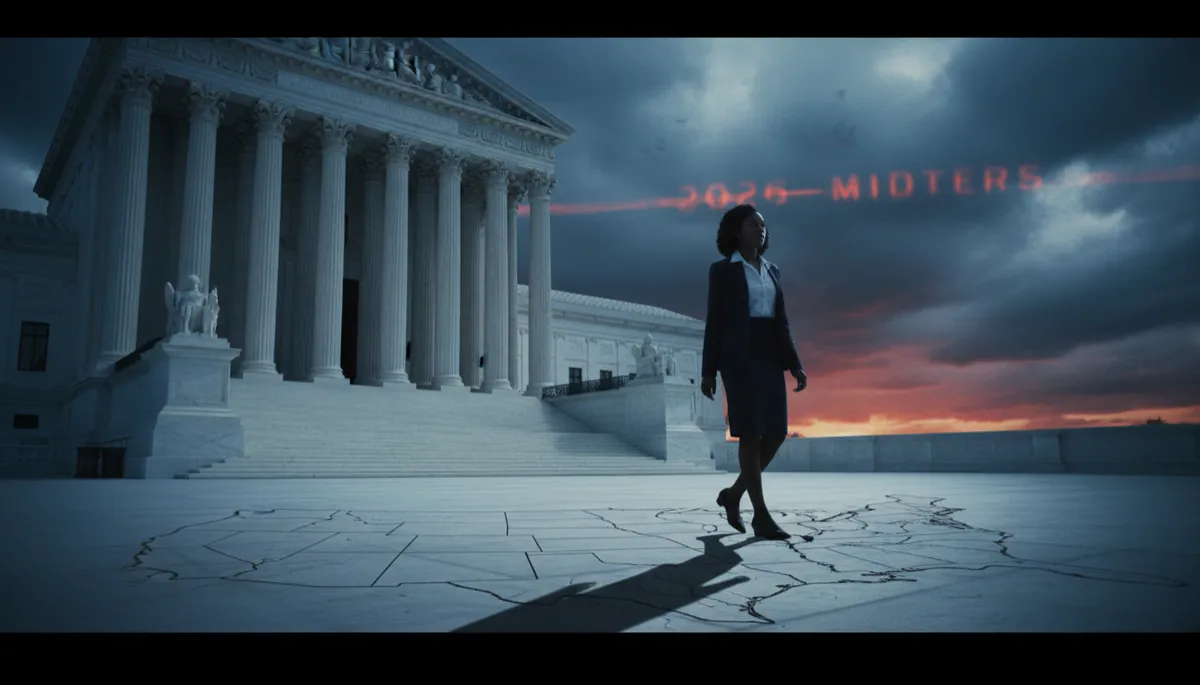
Supreme Court Sidesteps Key Voting Rights Fight, Leaving Black Voters Exposed for 2026
Politics, Voting Rights, Supreme Court
Supreme Court Sidesteps Key Voting Rights Fight, Leaving Black Voters Exposed for 2026
After weakening the Voting Rights Act in a high‑stakes Louisiana redistricting case, the Supreme Court has now ducked a direct answer to a question that could decide how effectively Black voters can fight back: who is actually allowed to enforce what remains of the law?
In Louisiana v. Callais, decided in late April, a 6–3 conservative majority struck down Louisiana’s congressional map that created a second majority‑Black district, calling it an unconstitutional racial gerrymander. The Court signaled that Section 2 of the Voting Rights Act cannot be used to require states to draw districts where Black voters can actually elect their candidates of choice, even when population numbers clearly justify it. The ruling narrowed Section 2 by elevating “race neutrality” over the real‑world impact on Black political power, and it did so with unusual speed, ordering the decision to take effect immediately so Louisiana could redraw its map before the 2026 midterms (Louisiana v. Callais, 2026; law.cornell.edu; cfr.org).
That alone was a major blow. But what the Court did next may prove just as consequential: it refused to say whether private citizens and civil rights groups can even bring Section 2 lawsuits at all. In separate redistricting disputes from Mississippi and North Dakota, the justices sidestepped the core question and quietly sent the cases back to lower courts instead of issuing a clear ruling on enforcement rights under the Voting Rights Act (Brennan Center; SCOTUSblog analysis of Section 2 cases).
At stake is the ability of Black voters to challenge maps that dilute their power. For decades, most Section 2 victories have come from suits filed by private plaintiffs: Black voters, grassroots coalitions, and national civil rights organizations. Now, Republican officials are arguing that only the U.S. Department of Justice can sue under Section 2, and that ordinary voters have no right to go to court when their districts are carved up along racial lines. If that argument ultimately prevails, it would gut the main tool Black communities have used to defend their voting strength since the 1980s (Brennan Center; lawfareblog.com on future Section 2 litigation).
By ducking the issue now and punting Mississippi and North Dakota back to the lower courts, the Supreme Court has done something shrewder—and more dangerous—than issuing a clean, headline‑grabbing ruling. It has delayed the showdown, effectively freezing uncertainty in place while states move full speed ahead on aggressive maps. That delay is not neutral. It buys time for Republican‑controlled legislatures to lock in new lines, knowing that challenges may stall or be thrown out entirely if the Court later declares that private enforcement is off the table. The justices have avoided a landmark decision—for the moment—but they have also cleared the runway for more maps that weaken Black voting power in 2026 and beyond (cfr.org; Brennan Center “Voting Rights and the 2026 Midterms”).
The impact on the 2026 midterms is direct and brutal. After Louisiana v. Callais, states like Alabama, Tennessee, and Virginia have already moved or attempted to reduce majority‑Black or minority‑opportunity districts, with courts increasingly reluctant to intervene (theweek.com; latimes.com). Now, with Section 2 enforcement itself under a cloud, Black voters face a double bind: fewer fair districts on the front end, and weaker legal remedies on the back end. Even if some lawsuits survive in the short term, the threat that the Supreme Court might later strip private plaintiffs of standing hangs over every case, encouraging lower courts to move slowly—or not at all—before November 2026.
Practically, that means fewer competitive seats where Black communities can decide outcomes, more safe Republican districts drawn with surgical precision, and a Congress even less reflective of Black political priorities on policing, economic justice, health care, and democracy itself. It also means that the burden shifts heavily from the courts to the streets: mobilization, registration, and turnout operations in Black communities will have to work against maps that are structurally rigged, not just against apathy or misinformation (Brennan Center; Pew Trusts on state voting laws and Black voters).
The Supreme Court’s message, read together, is stark. In Louisiana, the majority narrowed the substance of the Voting Rights Act. In the Mississippi and North Dakota cases, it ducked the question of who can enforce what remains. For Black voters heading into 2026, the warning is clear: the courtroom may not save you. Power will have to be built and protected at the ballot box, in state legislatures, and in Congress—before the Court takes the next step and decides, once and for all, whether Black communities are even allowed to sue when their votes are sliced apart.




