Trump Signs Executive Order to Cut Drug Prices: Who Really Benefits?
Politics, Health Policy, Prescription Drugs
Trump Signs Executive Order to Cut Drug Prices: Who Really Benefits?
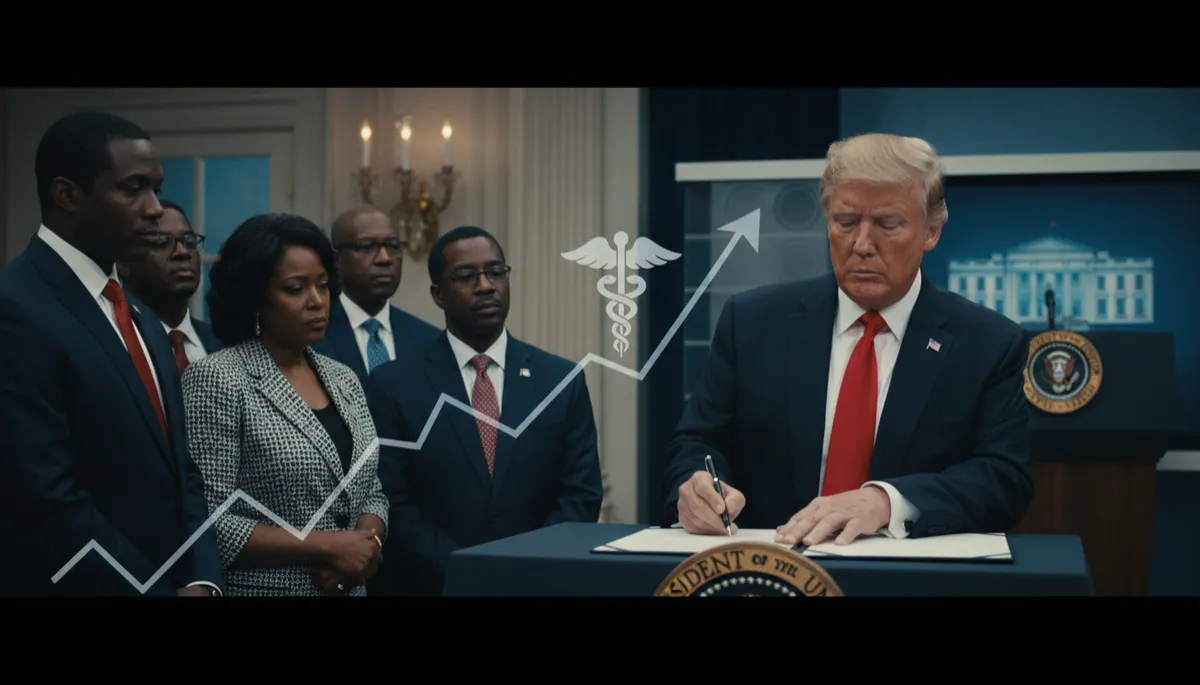
President Donald Trump has signed a new executive order in the South Court Auditorium at the White House, promising to slash prescription drug prices and “end the days of Americans paying the highest prices in the world.” The order sounds sweeping. The reality is more complicated—especially for Black Americans, who are more likely to be uninsured, underinsured, and locked out of affordable care.
The order, titled “Delivering Most‑Favored‑Nation Prescription Drug Pricing to American Patients”, directs federal agencies to push drugmakers toward “most‑favored‑nation” (MFN) pricing. In plain terms, the administration wants U.S. prices to match the lowest prices paid for the same drugs in other wealthy countries. Agencies like Health and Human Services and the U.S. Trade Representative are instructed to set pricing targets, negotiate with pharmaceutical companies, and use trade pressure—including tariffs—to force deals that bring down list prices.
The order also lays the groundwork for platforms like TrumpRx.gov, a direct‑to‑consumer site that now advertises deep cash discounts on high‑cost medications and hundreds of generics. The White House claims some drugs are discounted by 30–90 percent, and later MFN agreements with companies like Regeneron are projected to save Medicaid tens of billions over the next decade, according to administration estimates on WhiteHouse.gov. But those are projections, not guarantees, and they depend on voluntary deals with drugmakers who still control when and how new medicines reach the U.S. market.
Who Stands to Gain — and Who Is Left Out
In the short term, the clearest winners are uninsured and underinsured people who can pay cash and who take one of the specific drugs listed on TrumpRx or covered by MFN deals. For them, a lower sticker price at the pharmacy is real relief, especially for expensive medicines like insulin or GLP‑1 drugs used for diabetes and weight management. Some rare‑disease patients may also benefit from high‑profile arrangements, such as a Regeneron gene therapy offered at no cost under a recent agreement, according to White House fact sheets.
But most Americans still get their prescriptions through insurance, Medicare, or Medicaid. For them, the impact is murkier. Analysts and fact‑checkers like PolitiFact note that the order does not automatically rewrite insurance contracts, co‑pays, or deductibles. Many savings may be captured by insurers, pharmacy benefit managers, or state programs rather than showing up directly at the counter. There is also a risk that drugmakers respond by raising launch prices on new products or delaying U.S. releases altogether to avoid strict MFN benchmarks, a concern raised by health policy experts in outlets such as Health Affairs and Axios.
Big Pharma’s Grip on Pricing Power
The executive order lands in a landscape where Big Pharma still holds enormous leverage. In early 2026 alone, pharmaceutical and health companies spent more than $450 million on federal lobbying, according to OpenLobby investigations. The main industry trade group, PhRMA, poured in tens of millions by itself, relying heavily on former congressional staffers who know how to shape legislation and regulation from the inside. That influence helps protect the patent system, limit government negotiation, and slow more aggressive reforms like broad price caps or public manufacturing of essential drugs.
Even as the Trump administration touts MFN deals and tariffs, drugmakers have continued to raise list prices on hundreds of medications and launch new therapies at average prices above $300,000 per year, Senate Democrats reported this spring. One CEO told Axios the industry remained “financially unfazed” by Trump’s agreements, suggesting that while some discounts are real, the broader business model—and the power to set prices—remains largely intact. In that context, any single executive order is a nudge, not a full reset of how drugs are priced in America.
What This Means for Black Americans
For Black communities, the stakes are high. Black Americans are more likely to live with chronic conditions like diabetes, hypertension, and asthma—diseases that depend on consistent access to prescription drugs. At the same time, we are more likely to be uninsured or underinsured, to work in jobs without robust benefits, and to face hospitals and clinics that are under‑resourced or geographically distant. Any policy that lowers cash prices on essential medicines has the potential to narrow those gaps—but only if people can actually use it.
Here, the executive order’s limits matter. It does not expand Medicaid. It does not restore Affordable Care Act subsidies that helped many Black families afford coverage. It does not address transportation, pharmacy deserts, medical debt, or the racial bias that still shapes who gets prescribed newer, more effective treatments in the first place. In fact, if lower federal spending on drugs is later used to justify cuts to safety‑net programs, Black patients could end up worse off, even as headline prices fall for some medications.
Trump’s order is best understood as one piece of a much larger fight over who pays for medicine in America. It may deliver real savings to some Black patients who can navigate TrumpRx and pay cash. But without structural changes—stronger insurance coverage, enforcement of anti‑discrimination laws, and deeper challenges to Big Pharma’s political power—the communities hit hardest by high drug prices will still be asked to make impossible choices between health and everything else.