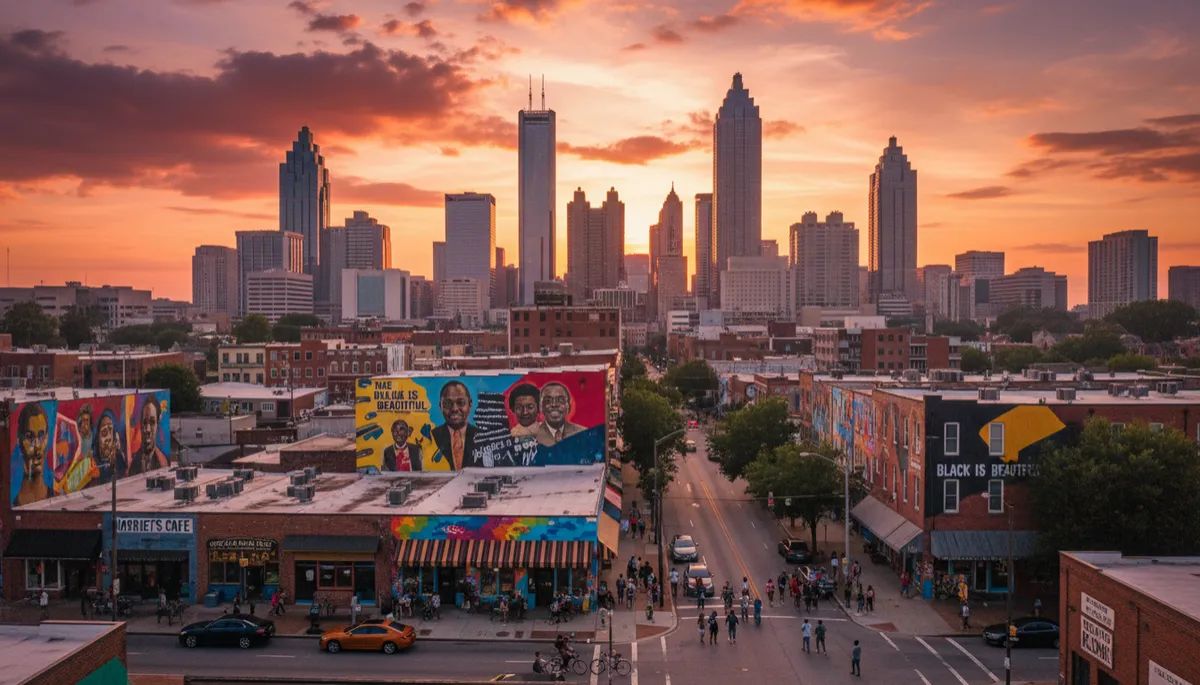
Vanishing Atlanta: How Gentrification Is Displacing Black Families From the City They Built
The City Built on Black Excellence — Being Erased Beneath the Surface
Atlanta has long occupied a singular place in the American imagination as the crown jewel of Black achievement — a city where Black political power, Black cultural influence, and Black economic ambition have flourished together for generations. It is the city of John Lewis and Maynard Jackson, of historically Black colleges and universities, of Sweet Auburn and the Sweet Auburn Curb Market, of Black-owned businesses that have served as anchors of community life for decades.
But beneath the gleaming skyline and the national narrative of Black success, a quieter and more devastating story is unfolding. Black communities are being systematically displaced from the very neighborhoods they built, the very blocks they sustained through decades of neglect, and the very city they made famous.
The data is unambiguous: according to the National Community Reinvestment Coalition, metro Atlanta ranks fourth in the nation among areas where gentrification has eliminated majority-Black census tracts. Of the 31 tracts that were majority-Black in 1980, nearly half had transitioned out of that designation by 2010 — and that trend has only accelerated since, driven by rising property values, development pressure, and a sustained wave of investment that often passes over or through Black communities without meaningfully benefiting the Black families who have lived there for generations.
Neighborhood by Neighborhood: The Displacement Map
The gentrification of Black Atlanta is not happening in one place — it is happening everywhere, often simultaneously, in ways that leave longtime Black residents feeling like strangers in their own city.
Old Fourth Ward, Edgewood, Reynoldstown, and Kirkwood: These communities, where Black families have owned homes for generations and built neighborhood life through churches, businesses, and civic organizations, are now among Atlanta's most sought-after real estate markets. Property values have surged, property taxes have followed, and longtime homeowners — particularly elderly residents on fixed incomes — are increasingly unable to afford to stay in homes they have owned for decades.
West End and the Westside: These neighborhoods have seen major waves of redevelopment, though community organizing has achieved meaningful victories. Resident coalitions have forced developers and city officials to negotiate community benefit agreements, slow-walked some of the most aggressive displacement projects, and created models for community-controlled development that other neighborhoods are now studying.
Summerhill: Residents successfully mobilized against a development project that community members argued would worsen environmental and infrastructure problems — and won a significant organizing victory that drew national attention.
South and Southwest Atlanta: These communities remain the most intact concentrations of Black residential and commercial life in the city, but they are not immune. Gentrification follows transit investment and development corridors, and as the Atlanta BeltLine expands southward — bringing the same property value increases and displacement pressure that transformed the Eastside — communities along its projected path face growing risk.
The BeltLine Paradox
No single project better captures the paradox at the heart of Atlanta's gentrification crisis than the Atlanta BeltLine. Simultaneously Atlanta's most ambitious infrastructure investment and its most powerful engine of residential displacement, the BeltLine has transformed former industrial corridors into some of the city's most desirable real estate — and in doing so, has priced out thousands of Black residents from neighborhoods they have called home for generations.
Property values near the BeltLine have surged dramatically — which sounds like good news for homeowners, but tells a more complicated story. Renters in BeltLine-adjacent neighborhoods face soaring market rents with no protection from displacement. Homeowners who cannot afford rising property tax bills face impossible choices. And the commercial character of neighborhoods — the Black-owned barbershops, beauty supply stores, soul food restaurants, and corner churches that define community identity — is often erased along with the residential population.
The Political Economy of Displacement
Gentrification is not a natural phenomenon. It is the predictable outcome of policy choices: which neighborhoods receive infrastructure investment, how zoning decisions allocate development rights, whether affordable housing is required as a condition of new development, and whether community land trusts and affordable housing programs receive the resources to compete with market-rate development.
In Atlanta, those policy choices have too often prioritized growth metrics that benefit developers, investors, and wealthier newcomers while failing to protect the communities that provided the city's cultural foundation and civic infrastructure. The result is a city that markets itself as the cradle of Black success while systematically making it more difficult for working-class and middle-class Black families to afford to live here.
What Black Atlanteans Can Do to Fight Back
- Know your rights as a tenant. Legal Aid Atlanta provides free assistance to tenants facing eviction, illegal rent increases, and habitability violations. Do not navigate the housing system alone.
- Support community land trusts. Organizations like the Westside Future Fund and the Atlanta Land Trust work to create permanently affordable housing by removing land from the speculative market.
- Attend zoning and development hearings. Decisions about what gets built where and with what community benefits are made at public hearings that most residents never attend. Your voice matters.
- Vote in every local election. City council, county commission, school board — these offices make the decisions that determine your neighborhood's future.
- Shop Black and support Black-owned businesses. Every dollar spent at a Black-owned business in a neighborhood under gentrification pressure is a vote for that community's survival.
- Organize with your neighbors. The communities that have won victories did so by organizing together, showing up consistently, and demanding that development serve existing residents rather than replace them.




